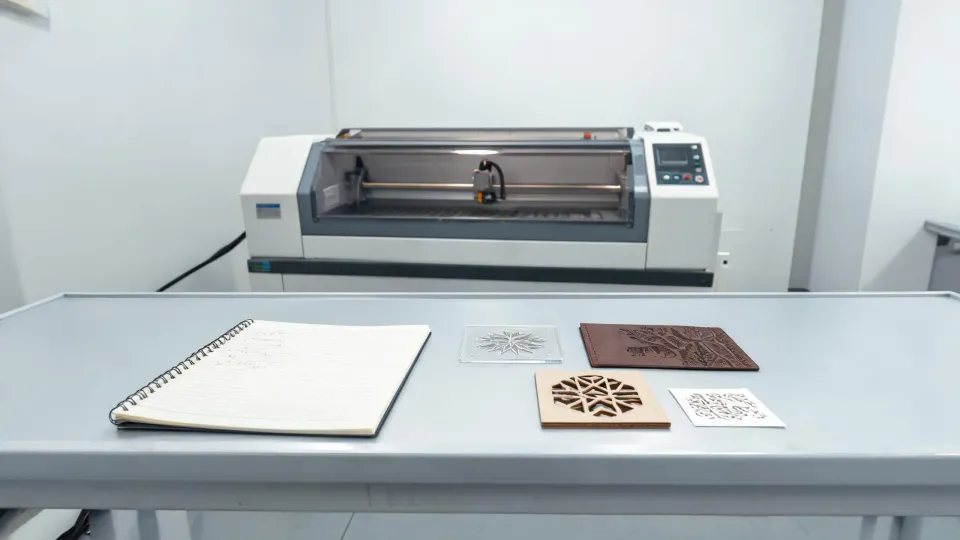
If you'd told me in early 2022 that our CO2 laser in Tulsa would become the most reliable piece of equipment in the shop, I would've laughed. Back then, it was the opposite. It spent more time misaligned than actually cutting. Honestly, I'm not exaggerating. I convinced my boss that a laser engraver would let us take on custom product requests—small-batch plaques, tags, prototype parts. I found a deal online. Three months later, I was the one explaining why we had a $4,000 paperweight that occasionally burned wood.
Here's the thing most people don't tell you: the machine isn't the problem. The purchasing decision is. I'm an office administrator, not an engineer. I handle procurement for a 30-person company that makes custom signs and industrial labels. My job is to keep operations running without overspending. So when I saw a cheap CO2 laser with "free shipping and 24/7 support," I jumped. That was mistake #1.
The symptoms started small. That's the sneaky part. Sharp lines looked wobbly by afternoon. Edges burned unevenly. The laser wouldn't cut the same thickness twice. We kept re-focusing, cleaning mirrors, adjusting belts. Every time we thought it was fixed, it drifted again. It felt like the machine was haunted. We joked about it, but the tension was real. A sign shop that misses deadlines loses credibility fast.
The real problem wasn't operator error—it was the beam path. In any laser cutter, the beam has to stay perfectly aligned across the X/Y gantry. That requires a rigid frame, solid optics mounts, and mirrors that don't shift with heat or vibration. Cheap machines cut costs in exactly those places. Ours had thin rails and mirrors held in plastic brackets. Every high-speed move shook the whole optical system. Temperature changes in the shop could move the beam by a visible margin between morning and afternoon. I didn't understand any of that until a service technician walked me through the mechanical tolerances. He pulled off the back panel and said, "This is your problem." It wasn't the software. It wasn't the lens. It was the whole structure silently flexing.
This is where a proper alignment tool changes everything. We finally ordered a Boss Laser alignment tool (boss-laser.com has them) after weeks of guessing. What it does is simple: it's a target that fits into the lens carriage, so you can see exactly where the beam is landing and adjust each mirror with real feedback. With our old setup, we were aligning by feel—moving a mirror, tightening a screw, hoping for the best. The tool turned a two-hour shot-in-the-dark process into a 20-minute check. It didn't fix the fundamental weakness of the machine, but it gave us a way to catch drift before it ruined a run. That was the moment I understood that good tools are cheaper than wasted hours.
But here's the part that really opened my eyes. The quality of the laser source itself matters more than most buyers realize. When we started looking at fiber lasers for metal marking, I learned about the fiber laser Gaussian apodization patent. The patent, assigned to JCZ, addresses the beam's intensity profile. Standard fiber lasers can produce a beam that isn't perfectly Gaussian, which causes inconsistent mark contrast and a fat heat-affected zone. The apodization method shapes the beam so it focuses tighter and more uniformly. In plain English? The pattern comes out clean the first time, instead of requiring ten test runs. We eventually bought a machine equipped with a JCZ fiber laser source. The difference was night and day—not just in speed, but in repeatability.
Let me put the real cost of "saving money" in numbers. Our cheap CO2 machine cost $2,800 less than a comparable Boss Laser model. (Actually, I should mention the Boss Laser quote included a warranty and training that the cheap one didn't.) In the first year, we spent $1,300 on replacement lenses and mirrors, many of which arrived misaligned. We paid $900 for two service visits that couldn't fully fix the issue because the parts were proprietary. We lost roughly $4,000 in production time because the machine was down or producing rejects. Add that up: $6,200 in extra costs—more than double the "savings." And that doesn't count the stress of every deadline hanging on a machine that might or might not work. If I remember correctly, we also refunded two customer orders because the engraving faded after we thought it was fixed. I should add: those refunds and lost repeat business are not in that simple math.
The most painful part was downtime. We're a small shop in Tulsa, and our clients don't care about our supply chain stories. They care about their orders. One late delivery cost us a repeat contract worth about $9,000 a year. You can't put that on a P&L line easily, but it's real. I remember sitting at my desk after that phone call, thinking, "I saved us $2,800, and it just cost us $9,000." That math still stings.
Looking back, there were warning signs I missed. The specs sheet kept saying "high-quality mirrors" without showing any test data. The "warranty" required us to ship the machine back at our cost if anything failed. The support line went to voicemail every time we called after 5 PM. Little things, but they add up. When you're excited about saving money, you tend to ignore red flags. I don't anymore.
When I finally proposed replacing the machine, I hesitated. It felt wasteful to spend more money after already investing in the cheap one. Maybe we hadn't tried hard enough? Maybe we could learn to live with it? I ran the numbers again, and that's when I realized the money was already gone. Continuing to throw cash at broken tooling is how small companies flush money down the drain. The longer we waited, the more the machine would cost us. We made the switch.
What changed? First, we bought a Boss Laser alignment tool and started doing weekly beam checks. It doesn't fix a poor design, but it catches drift before it ruins parts. Second, when we moved to fiber marking, we didn't shop by price alone. We looked at the laser source. We chose a system with a JCZ fiber laser because their work on Gaussian apodization, protected by patent, shows they care about the technical details that actually affect output. Third, we bought from a supplier who answers the phone when we have questions—not a drop-shipper who disappears after the sale. That might sound obvious, but after you've been ghosted by a support team, you never take it for granted again.
There's something satisfying about a machine that just works. After months of anxiety, seeing clean, repeatable cuts every morning is the payoff. I wouldn't trade that for a cheaper invoice.
So here's my advice to anyone in charge of buying a laser cutter or marker: the machine's price tag is probably the smallest cost you'll ever pay for it. The real expenses are the alignment tools you don't have, the parts you replace, the hours you lose, and the clients you disappoint. Take time to understand the beam path, ask about the laser source's technology, and verify after-sales support. It's not about being fancy. It's about running your shop without a weekly crisis. Bottom line: I'd rather own a $10,000 machine that works than a $6,000 machine that makes me look bad to my VP every month.
Prices and availability as of January 2025. Verify current specs with the supplier.