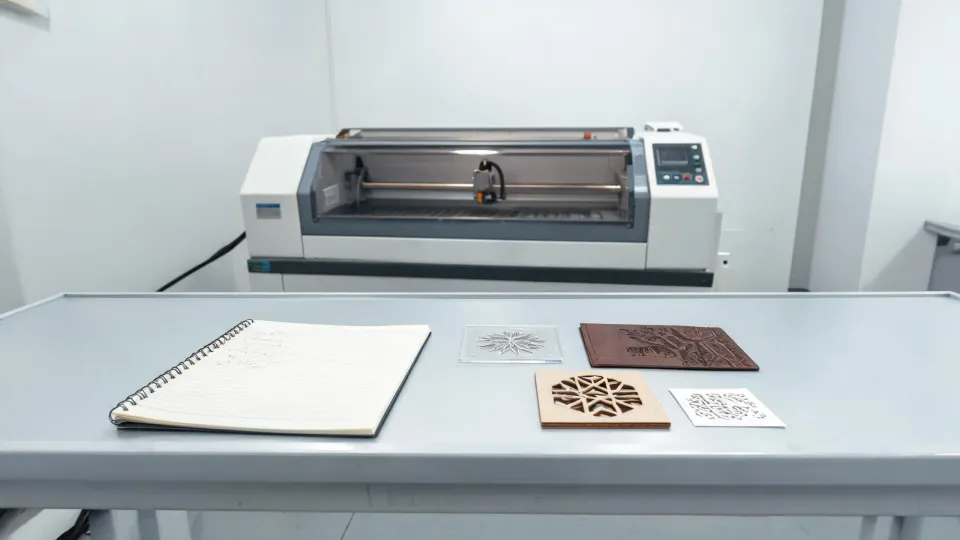
I'm not a laser engineer. I'm the person at a 40-person shop who signs the purchase orders, reconciles the invoices, and hears about it when a machine everyone "had to have" sits idle for three weeks.
So when we started weighing a CO2 machine against a fiber setup—specifically a 30 watt MOPA fiber laser—I did what I always do. I built a comparison. Not on beam quality or pulse frequency. On the things that actually decide whether a purchase survives its first budget review.
Four dimensions, in the order that matters to me: what each machine can actually do, what it really costs, who shows up when it breaks, and whether the vendor will even talk to a small buyer. That last one is a bigger deal than people admit.
Dimension 1: What Each Machine Actually Does
What does CO2 laser mean, exactly? A CO2 laser uses a carbon dioxide gas mixture and fires at roughly 10.6 microns. Organic materials absorb that wavelength well—wood, acrylic, leather, paper, glass, fabric, most coated metals. A fiber laser runs near 1,064 nanometers and gets absorbed by metals. That single difference drives everything else.
In practice, for our shop:
CO2 handled the signage blanks, the maple plaques, the acrylic display stands. Fiber handled the stainless tags, the anodized parts, and—this was the part I didn't expect—color marking on stainless. A 30 watt MOPA fiber laser can produce shades on stainless steel by varying the pulse. A CO2 machine can't do that at any wattage. That flipped our assumption that "more power wins." It doesn't. Wavelength wins.
Then again, fiber does almost nothing useful on clear acrylic. If that caught me off guard once, it confused three people on our ops team twice.
Dimension 2: The Real Cost Picture
Sticker price is the easiest number and the least useful. Here's the ballpark as I priced it in late 2024 and early 2025:
Entry desktop CO2 machines ran in the low thousands. Mid-size units with a 16×30 bed—what catalogs list as the 1630 frame, and what you'd see in the LS-1630 configuration Boss Laser sells—landed higher, with quotes depending on wattage, chiller, and extraction. The 30W MOPA fiber quotes we collected were in a similar range to mid-size CO2, but with a different long-run cost profile.
CO2 tubes are a consumable. They degrade and get replaced. Fiber sources typically last longer, but repair costs are steeper when something fails out of warranty. That's the trade: cheaper to run and costlier to fix, or the reverse, depending on which machine you pick.
Also worth pricing before you click buy: fume extraction, a chiller, spare lenses, and the electricity the thing pulls. Those quietly add 15–25% to the acquisition line. Our ops lead forgot to budget the chiller once. Once.
Dimension 3: Who Answers When It Breaks
This is where I stop pretending to be an engineer. I can't evaluate optical alignment. What I can judge is response times, parts availability, and whether the support line is staffed by someone who has actually run the machine.
CO2 laser services—alignment, tube replacement, mirror cleaning—come in two flavors. Either you learn to do them, or you pay a tech every time. Fiber services are more specialized, so you're leaning on the vendor more. Different risk profile per machine.
When I called Boss Laser's Sanford operation, a person picked up. That sounds trivial. It isn't. Two other vendors I contacted routed me through a ticket queue and promised a reply in "2–3 business days." For a machine that halts production, that's a red flag, not a feature.
Granted, one phone call isn't a track record. That said, it told me more about how the relationship would go than any spec sheet could.
Dimension 4: Will They Bother With One Unit?
This is the dimension nobody puts on a spec sheet, and it's the one that's cost me the most grief over the years.
Some vendors won't quote a single machine. They want a container, a distributor, or a dealer in the middle. I get why—transaction costs are real. But for a small shop trying to validate whether laser work is even worth insourcing, a minimum-order wall is often the quiet end of the conversation.
I have mixed feelings about this. On one hand, I understand that a one-machine sale doesn't fund a sales team. On the other, the vendors who took my single-unit inquiries seriously five years ago on other purchases are the ones I'm still calling today—now with larger orders. Small doesn't mean unimportant. It means potential.
I'll add one hard filter from experience: back in 2021, a new vendor cost us $2,400 in rejected expense reports because they could only produce handwritten receipts. Finance wouldn't touch them. Now I verify invoicing capability before I place a first order. Not romantic, but it's saved me twice since.
How I'd Actually Choose
If I had to decide tomorrow:
- Wood, acrylic, leather, glass, signage → CO2. It's the no-brainer category.
- Metal marking, stainless color, thin metal cutting → 30W MOPA fiber. More specialized, and worth the support premium.
- Mixed work with no clear majority → outsource the first ten jobs, then buy. Nobody I've worked with has regretted testing demand before spending five figures.
One thing I'd add for the first-time buyer: verify the price. I wrote these ranges in early 2025. Tariffs, tube supply, and the fiber source market move fast, so a quote from six months ago is basically a rumor. Call and ask.
And a last honest note: I'm not the person to ask about wavelength tuning or pulse shaping. That's an engineering question, and the right person to answer it is whoever will actually operate the machine. My job is making sure the paperwork is clean and the vendor answers the phone.
Bottom line: I'd rather buy the machine that matches the material and comes with a real support line than the one with the best brochure. The vendor who picks up at 9am on a Tuesday is the one who keeps the shop running.