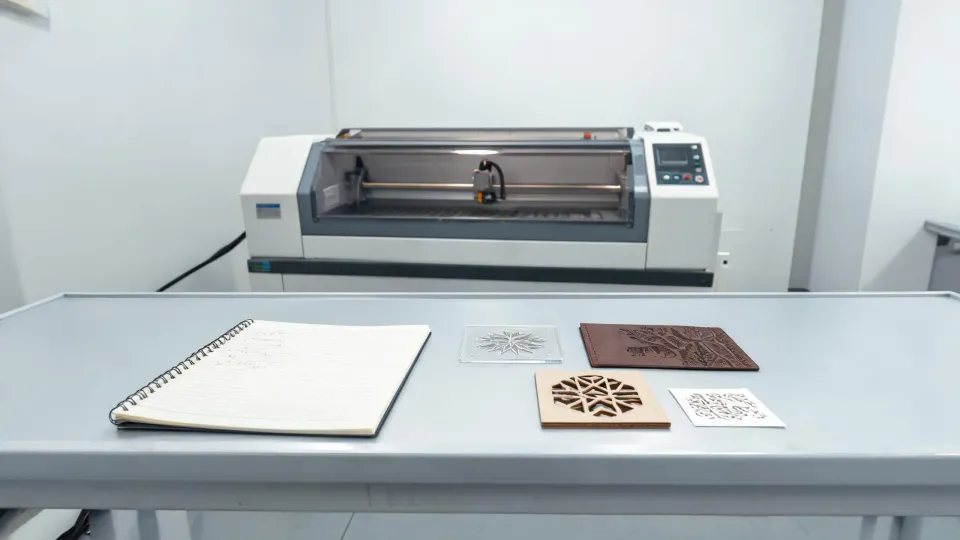
In Q2 2024, I put two laser options through the same cost analysis: a light CO2 laser and a fiber laser. The decision looked obvious from a YouTube video. It stopped being obvious once I got the full quotes.
I'm the procurement manager at a 24-person fabrication shop. I've managed our equipment budget for six years and have tracked about $180,000 in cumulative equipment, tooling, and aftermarket spend. When we finally ordered a machine, the one I'd expected to buy was not the one we ended up with. The shipping bill also taught me a lesson that I'll get to below.
Here's the short version before the details: a Boss Laser LS-1420 is a light CO2 laser good for engraving and cutting non-metals and coated blanks. A fiber laser is a different machine entirely, and it eats metal blanks for breakfast. The right choice depends on what 'blanks' means in your shop.
Why I'm comparing these two
I put this comparison together because most buyers start with the wrong question. They ask 'which laser is better?' That's like asking which vehicle is better: a pickup truck or a delivery van. The real question is: what are your blanks made of, and how fast do you need to move them?
Dimension 1: Metal blanks vs. everything else
If someone says 'fiber laser blanks,' they're usually talking about stainless steel tags, aluminum nameplates, brass key blanks, or any pre-cut piece of metal that needs marking. A fiber laser is the cleanest way to do that. It doesn't need marking spray or a coating on most metals. It just marks.
A light CO2 laser like the Boss Laser LS-1420 is the other side of the material chart. It cuts and engraves wood, acrylic, leather, glass, paper, and coated or anodized metal blanks. Bare metal is a problem for it because the beam reflects off the surface.
The first conclusion may surprise you: the material limitation cuts both ways. The fiber laser is faster on bare metal, but it's a one-trick pony for a mixed shop. If you make wood signs during the day and acrylic displays at night, the LS-1420 covers both. The fiber laser won't.
Dimension 2: Total cost of ownership, not sticker price
I don't compare the first number on the quote. I compare the number after I add every line item. That habit came from a mistake. In my first year, I approved a $3,200 equipment quote without asking about the rotary attachment and fixtures. The $3,200 machine cost $4,100 by the time it was ready to run. It wasn't the vendor's fault. It was mine. Now I ask one question before 'what's the price?' — 'What's not included?'
For the LS-1420, the machine itself is usually priced below a fiber laser. The tradeoff is speed. A fiber laser can mark a small stainless blank in seconds. A CO2 laser on coated blanks is slower, and on bare metal it needs a surface preparation step that changes your per-part cost.
Let me put it the way I put it in our budget spreadsheet:
- Boss Laser LS-1420 (light CO2 laser): lower entry cost, broader material range, slower per-part cycle on metal blanks.
- Fiber laser: higher entry cost, narrow material range, much faster on bare metal blanks.
If your revenue is metal blanks, the fiber can recover the higher price through speed. If your revenue is mixed materials, the CO2 machine is the one that works every day.
I should add that replacement parts matter. A CO2 laser tube has a finite life. Our last tube lasted about three years, though I might be misremembering the exact month. The replacement cost was less than a quarter of what we originally paid for the machine. That's still cheaper than a fiber laser diode repair, in my experience.
Dimension 3: Boss Laser shipping and setup realities
This is where 'boss laser shipping' becomes a real cost item. The LS-1420 ships as a wooden crate on a freight truck. It doesn't arrive through a parcel carrier. If you've ever watched an unboxing video, the crate usually appears in a warehouse or a driveway. They don't show the part where the freight driver refuses to wheel it into your shop.
Like most beginners, I made the classic crate error: I assumed 'freight' meant someone would unload it at our dock. Our dock couldn't accommodate the trailer, so the driver met us in a parking lot. We rented a pallet jack for $75 and spent four hours getting the crate across a curb into the shop. The machine was fine. My schedule was not.
Before you pay for a Boss Laser, ask for the shipping quote in writing and confirm three things:
- Is the delivery liftgate-equipped?
- Is it curb-side or inside delivery?
- Is the driver allowed to move it through a residential or garage doorway?
Per FTC guidelines (ftc.gov), advertising claims have to be truthful and substantiated. I extend that to shipping terms. If a quote says 'freight included,' I want to know exactly what that freight includes. The honest answer should be in writing.
Dimension 4: Fractional CO2 laser recovery day by day
This might be the strangest search term in this article, so let me address it directly. If you're looking for fractional CO2 laser recovery day by day because you're curious about a skin procedure, this is not that article. In the industrial world, I read 'fractional CO2 laser recovery day by day' as a question about part-time machine payback: if you only run a light CO2 laser a few hours a day, how does the cost recovery work day by day?
Here's the day-by-day plan I use after any new machine:
- Day 1: inspect the crate, check for damage, photograph everything.
- Day 2: set up and align the laser. Do test pieces, not paid jobs.
- Day 3: run one small paid job, even if it's a favor for a friend.
- Day 7: compare actual hours to the planner's estimate. If the first paid jobs took longer, adjust.
- Day 30: divide the total gross profit by the total cost of the machine, including shipping, tooling, and wasted material.
A fractional schedule—say, four hours a night—stretches that recovery calendar. That's not a bad thing if your goal is capability rather than high volume. But it means the machine's fixed costs, like floor space and maintenance, are spread over fewer hours. You need a realistic number of jobs to justify it.
The Boss Laser LS-1420 made sense for us because our jobs were fractional, not continuous. We engrave a dozen wooden pieces here and a batch of coated aluminum business cards there. No single job is big enough to justify a dedicated fiber laser.
What I wish someone had told me earlier
Looking back, I should have built a cost calculator before the first laser quote. At the time, I trusted the spec sheet and the sales call. Now I use a simple spreadsheet: one column for the quote, one for 'what's actually included,' and one for 'what it will cost when it's in my shop.' The difference between those columns is where purchasing decisions go to die.
Don't assume a rotary attachment is included. Don't assume exhaust, air assist, or a chiller is included. Don't assume the shipping company can get a 500-pound crate through a standard door. Ask. Then ask again.
Which should you buy?
If you're running bare metal blanks all day, buy a fiber laser. The Boss Laser LS-1420, or any light CO2 laser, will frustrate you on uncoated metal.
If you're running wood, acrylic, leather, glass, or coated blanks, the LS-1420 is the better first machine. It's less expensive to enter, more flexible, and easier to learn. The slower speed won't matter if your batch sizes are small.
And if you're really choosing between the two, make the decision on TCO, not on the sticker price. A quote that shows every fee upfront—shipping, liftgate, accessories, training—is the quote I trust. The cheapest first number usually isn't the cheapest final number. That's the lesson I've relearned every time I skipped the fine print.