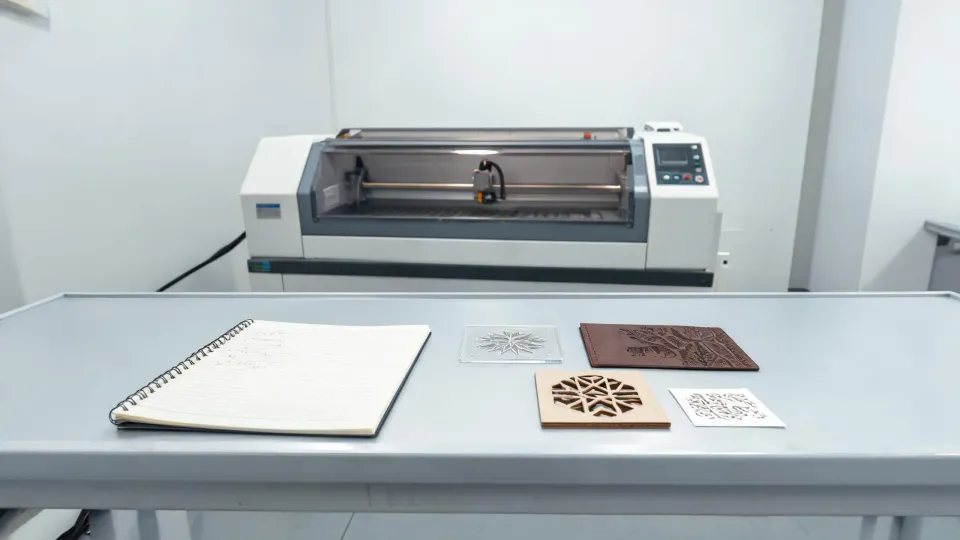
I think the worst laser machine I ever bought wasn't the one that broke down. It was the one that promised everything and delivered just enough to keep me from returning it.
I've been running a small laser cutting and engraving shop since 2018. In that time, I've personally made and documented five separate buying mistakes, totaling roughly $16,000 in wasted budget. That's painful to type. But it's lower than it would've been if I hadn't finally changed the way I evaluate lasers.
My current rule is simple: I don't buy a laser machine that claims to be good at everything. I buy the one that knows exactly what it's good at and can prove it. That's the whole article.
The 30W CO2 Laser Marking Machine That Taught Me About Boundaries
In 2019, I ordered a 30W CO2 laser marking machine. The product page used the words 'metal engraving.' That wasn't exactly a lie, but it was missing the boundary. A CO2 laser can mark certain coated or anodized metals. Bare steel, brass, and aluminum? Not a chance.
I found this out on a 150-piece order of stainless steel bottle openers. My logo needed to be permanent. My 30W CO2 left a faint mark that wiped off with a fingernail. I knew I should have tested the actual stainless steel before committing. But the machine had been reliable on anodized aluminum, and I told myself 'what are the odds?' The odds were 100%.
The job went to an outside shop and cost more than the markup I'd quoted. Total waste: about $2,100 in lost material, rework charges, and a customer's patience. Honestly, I'm still not sure whether that listing was intentionally vague or just written by someone who'd never run the machine. Either way, the lack of specifics was a red flag I ignored.
That isn't a bad machine. It's a machine used outside its boundary. That distinction matters because it changed me from cursing the manufacturer to questioning my own assumptions.
What the Latest CO2 Laser Still Can't Do
Fast-forward to 2021. The latest CO2 laser models had gotten better—faster motion control, more stable tubes, better software. I was tempted to believe the newest CO2 laser could eventually replace a fiber laser. It can't.
People hear 'latest CO2 laser' and assume the technology has crossed some fence. In terms of software, optics, and beam delivery, it has. But the underlying wavelength is still around 10.6 micrometers. That wavelength is ideal for wood, acrylic, leather, and a lot of plastics. Metals reflect most of that energy at room temperature. A fiber laser operates around 1.06 micrometers, which is a completely different interaction with metal. That's not a marketing distinction. It's physics.
Before that afternoon, I had read every forum thread about 'fiber laser JPT' as if the source name alone would settle my doubt. Then a friend who builds automation systems placed a block of aluminum on an old fiber marking machine with a JPT source. He pressed start, and the mark was there in under two seconds. Permanent, dark, impossible to rub off.
My CO2 machine couldn't do that. Not because it was old, but because the wavelength isn't absorbed the same way by metal. I now own both. A BOSS Laser LS1420 handles my wood, acrylic, and leather sheet goods. A separate fiber laser handles metal marking. They don't cross over. That's not a limitation of the equipment—it's the actual physics of how lasers work.
The Supplier Who Says 'No' Earns the Next Order
I learned more from a sales engineer's 'no' than from any spec sheet. When I was pricing a fiber system, I called BOSS Laser (boss-laser.com) and asked about their fiber lineup. The rep asked what materials I was running, listened to my volume numbers, and said, 'Honestly, you're not there yet. Your metal work is maybe $800 a month. Buy the CO2 for now, and send metal jobs out until you hit $1,500 to $2,000 monthly. Then call me.'
That's a hard conversation for a salesperson. It's also the conversation that sold me the LS1420. Per FTC guidelines (ftc.gov), advertising claims must be truthful and substantiated. But a supplier who volunteers boundaries is doing something better—they're showing they care about the match, not just the sale.
If you're shopping for a BOSS Laser cutting machine, ask that same question: 'What is this model not good at?' The sales team should answer without hesitation. If you get a long pause or a vague pitch, that's a warning sign.
Since that call, I've referred two other shop owners to BOSS Laser. Not because I got a discount, but because the rep's honesty made my own recommendation safe. That's trust no advertisement can buy.
But What If You Actually Need Both?
Here's the objection I expect: 'I can't afford two lasers.' I understand, because I couldn't afford to keep failing. Let me save you the math: a $2,000 experiment that sits idle after you discover the wrong wavelength costs more than subcontracting until volume justifies the second machine.
In my shop, I run acrylic signs on the LS1420 and send stainless steel parts to a nearby metal finisher. If that relationship ever turns into $2,000 of monthly metal work, I'll buy a fiber laser with a JPT source. Not before.
I also keep a pre-purchase checklist now. It didn't exist before 2021, because I thought I could keep the process in my head. That's how I ended up with two machines I didn't need in the same year. Now every potential purchase gets the same questions.
That doesn't make my shop small. It makes it honest about scope. My sample size is one shop, mostly 100- to 300-piece orders and custom work. If you're running high-volume metal marking, your math will be different. But the principle won't be.
Buy the Laser That Knows Its Limits
I'm not against powerful machines. I'm against promises that don't match physics. A 30W CO2 laser marking machine is a great tool for certain materials. The latest CO2 laser models are genuinely impressive. A fiber laser JPT source is the right answer when you need permanent metal marking. And the BOSS Laser LS1420 is a dedicated CO2 workhorse with honest boundaries.
If this article sounds like I'm arguing that you need to buy two expensive machines, I'm not. I'm arguing that you need to know what your material requires before you let a feature list decide. The best laser cutting machine for a woodworker is not the same as the best laser cutting machine for a metal fabricator. A dedicated machine with honest boundaries beats a multi-purpose machine with vague promises. Every time.
Before you buy, ask one question: 'What is this machine bad at?' If you get a straight answer, you've found a trustworthy supplier. If you get a sales pitch, run. I learned that the hard way, so you don't have to.