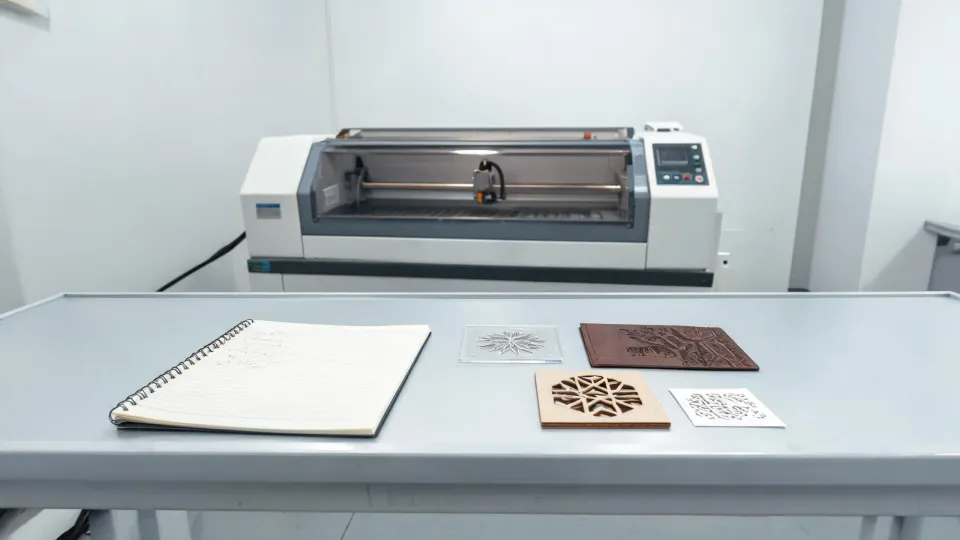
I run a small custom fabrication shop, and I still remember the knot in my stomach when I signed the purchase order for my first laser cutter in January 2017. The price was about 45% below the equivalent BOSS Laser LS1420, and I convinced myself the difference was just brand markup. It wasn't.
It's tempting to think a CO2 laser cutter is really just a wattage number. But a CO2 laser cutting system is a chain: tube, mirrors, focus lens, air assist, controller, software, and support. A weak link in any of those turns into downtime.
The $3,200 Mistake
For the first few months, the machine ran fine. Then came a real deadline order: 120 engraved acrylic display bases for a regional retail chain, due in five days.
About 40 pieces in, every tenth piece started coming out with a burned edge. I cleaned the lens. I reduced speed. I increased power. Nothing fixed it consistently. A repair technician eventually found the problem: the second mirror in the CO2 laser beam path had a degraded coating. It could not handle sustained heat, so I was dealing with a weak CO2 laser mirror that should have lasted much longer.
The mirror itself cost maybe $38. The cost of not having it on hand was the real problem. The seller I bought the machine from did not answer my support emails, and the quoted replacement would take 11 days. I found a generic mirror through a local repair contact and paid the technician overtime to install and align it.
By the time it was over, I had refunded one batch, reworked another, and missed one deadline completely. Add the repair bill and lost shop hours, and the total landed around $3,200 in wasted budget. Worse, one of those customers never came back.
I should have replaced the machine right then. Instead, I kept it running, told myself the spare parts stock was enough, and waited for it to really die.
September 2022: The Day 'Probably' Stopped Being Good Enough
September 13, 2022, 9:14 a.m. A museum vendor had sent over a 150-piece acrylic order, and the delivery deadline was Friday at 4:00 p.m. I cut a test piece, and the rough edge was back.
I opened the beam path, cleaned the CO2 laser mirror, and swapped in my spare. It did not help. The repair technician who came by gave me the honest diagnosis: the rail that carries the laser head had enough wear to cause slight misalignment at speed, and the controller was occasionally dropping steps. The machine could be fixed with a 9-day lead time. The order in my hand had to be delivered in four.
That is when I called BOSS Laser. The LS1420 was in stock at their facility, it could ship the same day, and they could have a technician walk me through setup on the phone. It cost roughly $1,700 more than a generic online machine with the same listed work area—but the generic machine had a 10-day estimated lead time and no one who would answer my questions.
I did not pay the extra money for a logo. I paid for a date: equipment that arrives when promised, support that answers, and a parts chain that actually exists.
What the BOSS Laser LS1420 Actually Did
The LS1420 arrived the next afternoon. We ran the first test cut within a few hours, and by Thursday evening the 150-piece order was cut, engraved, and packed. The machine held alignment through the whole run. That is not a dramatic story, but in a small shop, boring reliability is the whole point.
I am not saying the LS1420 is magical. It cuts the same materials any CO2 laser cuts: wood, acrylic, leather, paper, some textiles, and coated metals for engraving. It did not make my designs better. What it did was show up exactly when it was promised and keep running during a deadline. For us, that was the feature that mattered.
The Checklist I Use Now
After the 2017 failure and the 2022 decision, I made this the standard for our shop. It has caught four potential bad purchases since.
- Compare the optics chain, not just the wattage. Ask about the CO2 laser mirror and focus lens. What grade are they? Does the seller stock replacements? A cheap mirror with poor coating can fail in a way that looks exactly like a tube problem.
- Ask a technical question before you buy. Send a support ticket or email and see how long the response takes. If they cannot help you before the sale, they probably will not help you after it.
- Price a spare parts kit into the purchase. A $38 mirror is only cheap if you already have it on the shelf. Without it, the same small part can cost you a $9,800 order.
- Choose the right laser category for your work. The BOSS Laser LS1420 is a CO2 laser, so it is ideal for acrylic, wood, leather, and coated metals. If your main product is bare metal tags, a small laser engraving machine for metal—usually a fiber laser—is the tool you actually need. No CO2 laser will do that job well.
To be fair, not every budget laser machine fails. Some shops run them for years without trouble. But those shops usually have spare time, mechanical skills, and flexible delivery dates. We do not. Our customers care when something shows up, and missing one deadline damages trust faster than any equipment discount can repair it.
I kept a $3,200 mistake alive for years because I did not want to admit the real cost was certainty. The BOSS Laser LS1420 was not the cheapest purchase we could have made, but it was the first time I understood that in deadline work, the opposite of cheap is not expensive. It is certain.