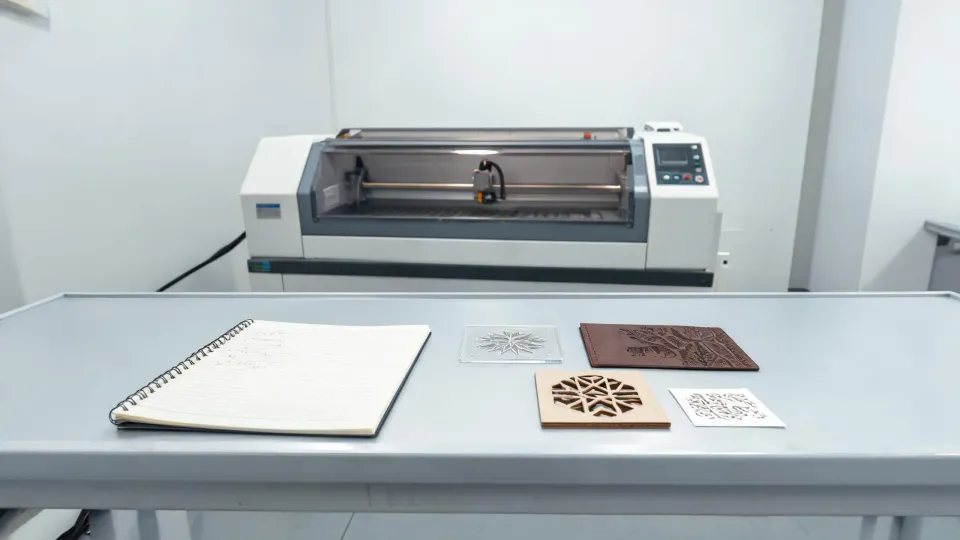
If you ask me, the laser buying process is backward.
Most buyers spend weeks comparing machine specs, brand reputations, and price tags. They watch comparison videos. They ask "which one is better, A or B?" And then they get the machine home and spend the first month confused about why their cuts are charred, their engravings look blotchy, and their acrylic won't cut clean.
I'm a technical support lead at a laser equipment company. In the last six years, I've handled 400+ emergency support calls—the kind where a client's production line is stopped, or an order is due tomorrow, and the machine "just stopped working right."
Here's what I've learned: most of the time, the machine wasn't the problem. The settings were.
Not the brand. Not the laser tube. Not the "quality of components." The settings.
So I'm going to make an argument that sounds counterintuitive if you're shopping for your first laser: stop comparing laser machines before you understand what power settings and material settings actually do. Because once you understand that, brand comparison becomes a lot easier—and a lot less important than you think.
Power Settings Decide More Than the Machine Does
When I'm triaging an emergency call, the first thing I ask for isn't the machine model. It's the material. The thickness. And the power/speed settings they're running.
Concrete example. In March 2024, a customer called who runs a small manufacturing shop. They had 200 engraved acrylic plaques to deliver in 36 hours. Their CO2 laser was "ruining" every piece—melting the edges, leaving white marks. They were ready to ask for a replacement machine.
Then I asked for their settings. 90% power at 20 mm/s on 5mm acrylic.
That's way too much power for that speed and thickness. The beam is basically sitting on the material long enough to melt it, not cut it. We walked him through a boss laser power settings baseline—roughly 60% power at 30 mm/s on that material—and the next piece came out clean.
He didn't need a new machine. He needed a starting point.
And he's not alone. Based on our internal data from 400+ support requests, I'd estimate that roughly 40% of "the machine is broken" calls were actually "the settings are wrong" calls. The machine was doing exactly what it was told. The problem was the instructions.
That's not a knock on customers. Power settings take time to learn. But it tells you something useful: operator skill matters as much as machine quality.
Here's another angle. The same lesson shows up when someone calls about a "bad lens" or "dirty optics." About a fifth of those end up being a focus or power issue, not actual hardware damage. We've had customers replace brand-new lenses unnecessarily because a simple Z-distance adjustment would have fixed the problem. A replacement lens can cost several hundred dollars. That's an expensive way to learn about settings.
Material Settings Are the Real Learning Curve
This brings me to a broader point. The real learning curve in laser work isn't the machine—it's the materials.
I'm not a materials scientist, so I can't speak to the chemistry behind it all. What I can tell you from a support desk perspective is that the same machine, with the same settings, produces completely different results on different materials. That surprises new buyers more than almost anything else.
- Wood chars at high power; you need to find the speed that keeps the cut clean.
- Acrylic melts if the beam lingers; frequency and speed have to work together.
- Glass fractures with too much heat; low power and a coated work surface make the difference.
- Metals won't respond to a CO2 laser at all—you need a fiber laser for marking steel or aluminum.
When customers ask where to begin, I point them to the boss laser material settings library. It's a collection of tested starting points for common materials and thicknesses. Not because it's the only guide out there, but because it removes the guesswork for the most common scenarios. Start there, test, adjust. That process is the skill.
There's something satisfying about watching a customer who's been fighting their machine for weeks suddenly produce clean cuts because they found one working setting. After all the stress and troubleshooting, seeing it click—that's the payoff.
The Laser Market Is More Confusing Than People Realize
Here's the counterintuitive part. The word "laser" covers a ridiculously broad range of technology, and buyers end up comparing things that aren't even in the same category.
Try searching "CO2 laser" sometime. You'll get industrial cutting machines. You'll also find medical devices—Sciton's CO2 laser system, for example, is a skin resurfacing tool. Completely different application. A hobbyist looking for a desktop engraver can fall down the medical aesthetics rabbit hole before they even find the right category.
Same confusion on the fiber side. If you're in Europe—say, running a shop in Belgium or the Netherlands—you might search for "fiber laser Benelux" suppliers to find someone local. That's smart. But you'll also get academic papers on laser physics. Some fascinating stuff out there, including patents on quantum chaos cladding in optical fiber lasers. Interesting reading, but absolutely not relevant when you need to mark serial numbers on steel parts by Friday.
Here's my point: most buyers aren't comparing similar machines. They're comparing categories they don't understand. And that's why settings knowledge matters so much—it forces you to think about what the machine actually has to do. The material you're processing. The power it needs. The speed that works. The type of laser that can handle the job.
CO2 lasers are for organic materials: wood, acrylic, glass, leather, paper. Fiber lasers are for metals. They're not competitors. They're different tools. Knowing your materials—and their required settings—tells you which one you need more reliably than any comparison chart.
This is why I get a little frustrated when buyers ask "which brand is best?" before they've answered the more basic questions: what materials will I process, what quality do I need, and what does my production volume actually require? The brand conversation makes way more sense after those questions, not before.
But What About Brand Reliability?
I know what you're thinking: "Fine, but if the machine breaks down, settings won't save me."
Fair. Brand reliability is real, and it matters. If you buy a cheap machine and the laser tube dies after six months, no power setting guide in the world is going to fix that.
But here's what I see from my seat: even the most reliable machine will produce garbage output if the settings are wrong. I've seen premium machines making bad pieces because the operator was guessing instead of testing. And I've seen budget machines producing excellent work—slowly, but well—because the owner understood their materials.
What actually makes the difference is a combination: a machine with reasonable reliability, and a support team that helps you learn the settings. The customers who succeed aren't the ones who bought the most expensive machine. They're the ones who bought from someone who picks up the phone and walks them through a material test.
That's why I'd rather spend 10 minutes explaining settings options than deal with mismatched expectations later. An informed customer asks better questions and makes faster decisions.
And this is also why I push back on the "cheapest machine first" strategy. It sounds smart until you count wasted materials, hours of troubleshooting, and a customer order that ran late. Total cost includes your time and your scrap rate. Not just the sticker price.
What You Should Actually Do
If you're shopping for a laser right now, try this order:
- List the materials you plan to process in your first six months.
- Look up the typical power and speed ranges for those materials.
- Ask the vendor: "Do you have tested settings for these materials, or do I have to figure it out on my own?"
- Then ask about support: response time, repair parts, technical help after the sale.
The last one is the question most buyers skip. Not "which brand has the best laser tube" but "who's going to help me when cut quality changes for no obvious reason?"
Because that moment will come. It always does. Don't hold me to this, but I'd guess every laser owner hits a "why is it suddenly bad?" moment within their first year. The question is whether you go through it alone.
Bottom Line
Comparing laser machines is fine. You should compare. But comparing brands before you understand power settings and material settings is comparing the wrong things.
My experience is based on CO2 and fiber machines in small-to-mid-size production environments. If you're looking at large-format industrial systems, some of these details might differ. But the core lesson holds—and I've watched it play out hundreds of times.
The machine is a tool. The settings are the skill. And the skill is what produces good work.
Learn the settings. Understand your materials. Then pick the brand.
That's the order that works.