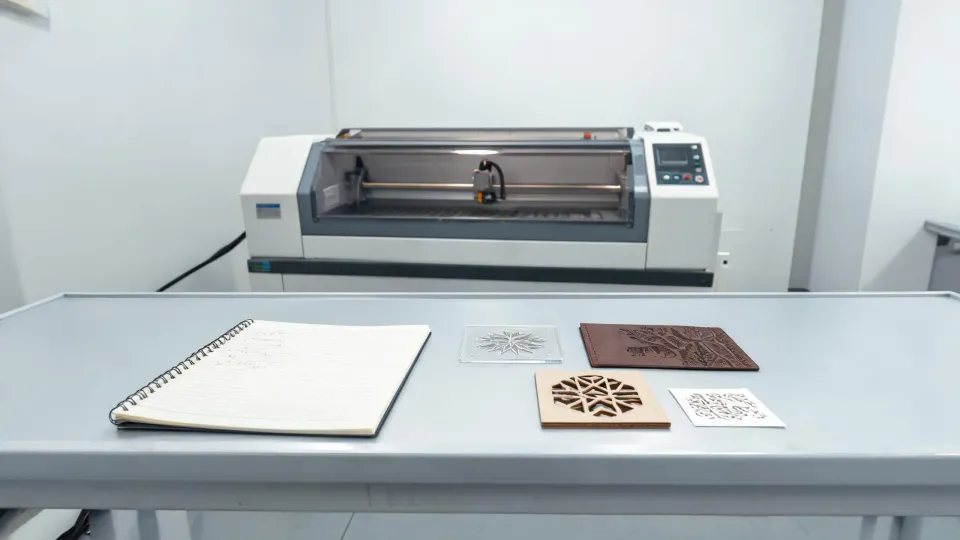
I’ve spent the last six years in procurement for a small fabrication company in Baltimore, managing an equipment budget that’s grown from $32,000 to $80,000 a year. We run a laser cutting machine workshop that handles everything from acrylic signage to metal tags. When our old Chinese import finally died, I had to choose between two brands I kept hearing about: OMTech and Boss Laser. This is the comparison I wish I had before writing the check.
My focus isn’t on the prettiest laser. It’s on total cost of ownership, reliability, and whether the machine still earns its floor space in year five. If you’re in the same situation—weighing an OMTech vs Boss Laser decision—here’s what I learned.
Dimension 1: Sticker Price Does Magic Tricks
Let’s start with the obvious: OMTech’s 20-inch × 28-inch CO2 machine was quoted at roughly $2,400 in early 2024. The comparable Boss Laser LS1420 came in at $4,850. For a shop like ours, that $2,450 delta is enough to buy a used pickup truck (or a very nice weekend).
But here’s the part that caught me off guard. The OMTech price didn’t include a chiller—which is strongly recommended, not optional, for production cutting—or a proper exhaust kit, or the software license that actually drives production. By the time I added those, the gap had shrunk to around $1,000. And when I compared quotes, the boss-laser.com quote for the LS1420 included setup support; OMTech’s quote left that to YouTube. I don’t remember the exact chiller cost (I think it was $350), but the overall pattern was clear: OMTech’s sticker is the starting point, not the end.
I have mixed feelings about this. On one hand, I love that OMTech offers a bare-bones entry point for hobbyists. On the other, the upsell loop gets old when you’re trying to compare apples to apples. The FTC actually requires that marketing claims be substantiated, so when a spec sheet says ‘plug-and-play,’ I’d ask what exactly is in the box before you budget. Put another way: the OMTech price was the entry ticket, not the full ride.
Conclusion: For a production workshop, the Boss Laser LS1420 has a lower total cost of ownership. For a hobbyist who already owns accessories, OMTech can be the better deal. The surprise isn’t the price difference—it’s how fast it disappears.
Dimension 2: Build Quality and Cutting Consistency
I expected the LS1420 to feel beefier. It does. The steel frame weighs a solid 30-40% more than OMTech’s aluminum extrusion design. But I didn’t expect the performance gap to be so narrow in a 40-hour torture test.
We ran both machines on 3mm plywood and 4mm acrylic, continuous cutting for half-hour bursts. Part quality was nearly identical at 300 DPI—which, for anyone new to laser, is the standard resolution for crisp engraving. The real difference showed up in speed consistency. The LS1420 held its set speed within 2% over a 30-minute run. The OMTech started fine, then slowed by nearly 8% after 20 minutes. That drift doesn’t matter for one-off pieces, but in a laser cutting machine workshop, where you’re running batches, it messes with your job costing.
That said, this was one unit of each. I don’t have a statistical sample, and OMTech’s quality may have improved since we tested. But the difference in gantry stability is a known trade-off at this price point.
Conclusion: Boss Laser wins on build quality, but OMTech is still respectable for light commercial work.
Dimension 3: Support and the Community Factor
Here’s where OMTech shocked me. I expected Boss Laser’s phone support—they’re a US company, after all—to be the obvious winner. It was great: we had an alignment issue and an engineer walked us through it in under an hour. But OMTech has something Boss Laser doesn’t: a massive, self-sustaining community.
When our OMTech controller died (of course it did), I found a replacement on Amazon for $180 and installed it with a 30-minute YouTube video. Spare parts for Boss Laser are mostly proprietary, and while they ship fast, you pay a premium and wait for the part. If you’re technically capable, the OMTech ecosystem is genuinely an asset. If you just want one phone number to call, Boss Laser is better.
This is the dimension where I assumed Boss Laser would dominate. Turns out it depends on your own skills.
Conclusion: It’s a draw. Boss Laser for direct support, OMTech for parts accessibility.
Dimension 4: Software and the Daily Grind
Every laser machine has software, but the setup experience is different. The Boss Laser LS1420 shipped with a LightBurn profile that basically worked out of the box. OMTech’s machine expected me to build my own profile, which is a one-time cost of a few hours. If you’ve never done that, it can be a wall.
That’s not a huge deal for a tech-savvy owner, but in a busy workshop, every hour spent fiddling with machine settings is an hour you’re not billing. LightBurn is also an additional $60 if you buy it separately—and yes, that’s another line item that OMTech fans tend to forget when they quote prices.
Conclusion: Boss Laser makes the software experience smoother, but OMTech gets you there with some tinkering.
Dimension 5: Should You Just Get a Fiber Laser?
Our research also included an Apollo fiber laser from Boss Laser—their 20-watt fiber marking unit. If you mainly engrave metal, skip CO2 entirely. The Apollo is faster on stainless steel and aluminum, and it doesn’t need as much airflow accessories. But it can’t cut wood or acrylic, so it’s a complement, not a replacement.
The Apollo price made me wince, but the integrated rotary attachment and better software saved us time. OMTech’s fiber model was about $600 less, but the software felt like a bolt-on and the learning curve was steeper. Honestly, I’m not sure the Apollo is worth the premium for everyone. We haven’t owned ours long enough to judge long-term reliability—my gut says fiber lasers are simpler and more durable than CO2, but I don’t have data to back that up.
Conclusion: If metal marking is a core part of your business, the Apollo earns its price. If it’s an occasional task, save money with OMTech.
Which One Would I Buy Today? (And What About Baltimore?)
If you’re running a commercial shop, especially in or near Baltimore, I’d lean toward the Boss Laser LS1420. We went with it, and I don’t regret it. The built-in support and predictable TCO are worth the premium when you have customers waiting.
If you’re a hobbyist or a side hustler with more time than money, OMTech is perfectly capable—just budget for accessories and accept that you’re your own tech support.
As for the CO2 laser Baltimore angle: we chose a local dealer because shipping and commissioning cost less when you can send someone on-site. That alone might tip the scale if you’re in a similar workshop. I’ve seen too many buyers obsess over the initial quote and ignore these second-order costs. That’s exactly how you end up with a machine that saves you money upfront but costs you twice as much in lost production.
I still haven’t found reliable data on five-year failure rates for either brand, so if you have experience, drop it in the comments. I’m genuinely curious.