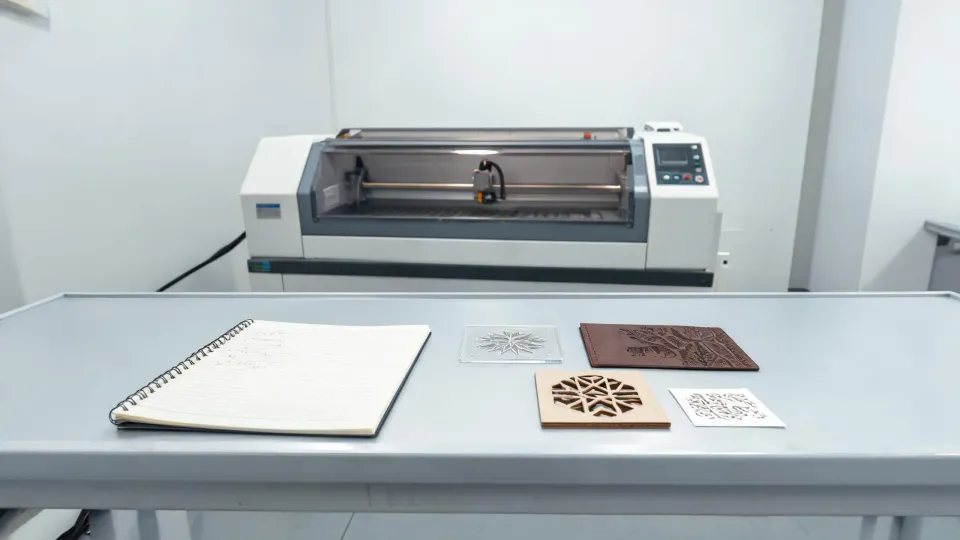
I've been running a small laser workshop since 2018, handling custom engraving and cutting orders. I've personally made three significant equipment-buying mistakes, totaling roughly $9,700 in wasted budget. Now I keep a checklist so I don't repeat my errors.
If you're reading this because you searched "co2 vs diode vs fiber laser," you know the drill: forum threads full of strong opinions, zero context. Let me give you context. There's no universal best laser. The right machine depends on what you're cutting, how often, and—most importantly—what it costs you over its lifetime.
Here's a preview of the three scenarios:
- You work with wood, acrylic, glass, leather, or fabric → CO2.
- You're on a tight budget and only need small, thin, soft jobs → diode can work, but understand the tradeoff.
- You process metal or need precision surface removal → fiber.
Scenario 1: CO2 for Non-Metals
CO2 lasers use a 10.6 µm wavelength, which organic and plastic materials absorb well. If your daily work is cutting acrylic signs, engraving wood panels, or etching glass, a CO2 laser is the workhorse. I started with a cheap CO2 unit, and I thought I was being smart. The machine was $3,200 instead of $4,000, and that $800 savings felt great.
Then the tube died. Replacing a CO2 tube is not like swapping a lightbulb. You need to check alignment, maybe replace mirrors and lenses, and you lose production time. My cheap tube lasted about 1,200 hours—the better tube in my friend's machine went past 3,000. The replacement cost, shipping, and downtime wiped out that $800 saving. That's the first lesson: the price tag is not the cost.
When I finally bought a BOSS Laser CO2 machine (boss-laser.com), I searched for "BOSS Laser tube replacement" before purchasing. Their site actually listed compatible replacement tubes and lenses, which made the TCO calculation concrete. Generic replacement parts can be cheaper, but waiting three weeks for a part that almost fits isn't worth it if your income depends on the machine.
Scenario 2: Diode Lasers Aren't "Budget CO2"
I also own a diode laser. It was my second mistake.
The logic: "It's only $850. I'll learn on this and upgrade later." The reality: I spent a month fighting a 20W diode laser that charred edges, needed three passes on 3mm wood, and had a tiny focus spot. Yes, it engraved leather beautifully. But for real customer orders, it was embarrassingly slow.
I thought I was saving $2,000. Let me rephrase that: I was saving $2,000 on the initial quote, but losing $60 per hour of my time as I waited for passes to finish. After one month, I ordered a CO2 machine. The diode became a paperweight. My total spend was $850 + $3,200 = $4,050. If I had bought the CO2 first, I'd still have had $850 in my pocket.
Am I saying diode lasers are useless? No. I'm saying they serve a narrow niche: small batch work on thin, soft materials where speed and cut quality don't matter much. Hobbyists, craft fair smalls, model makers—that's the honest market. If you plan to run a production shop, a diode laser is not a stepping stone; it's a detour.
Scenario 3: Fiber Lasers for Metal and Precision Ablation
Fiber lasers use a 1.06 µm wavelength, which metals absorb far better than the CO2 wavelength. When you need to mark steel, engrave anodized aluminum, cut stainless, or weld thin metal, fiber is the standard.
This is where the keyword "fiber laser ablation" shows up in real work. We've used it to remove rust, strip powder coating from small parts, and clean surfaces before welding. It's precise enough to handle delicate components that blasting or chemical stripping would ruin.
A quick warning about "CO2 laser welder" labels: if you see a cheap "CO2 laser welder" advertised for metal, be suspicious. In production, most laser welding is fiber or YAG. A CO2 laser will not weld steel effectively. I almost bought one because it was cheap; a fabrication buddy stopped me. That mistake could have cost me way more than $9,700.
Fiber units have a higher up-front price but much lower consumable costs. There's no tube to replace. Per the spec sheet on my BOSS Laser fiber unit, the source is rated for 100,000 hours. In late 2024, I picked up a fiber unit for $4,500, and it paid off when I landed a recurring metal-marking order at $800/month. I want to say payback was six months, but don't quote me—spreadsheets say it was closer to seven.
But fiber isn't magic. It won't cut acrylic well; clear acrylic needs CO2. And if you buy a fiber laser without clients, the machine sits idle. That idle time is part of total cost too.
How To Decide Which One You Need
Stop asking "which laser is better?" Ask "which laser is better for my specific jobs?"
Here's the checklist I use now:
- What materials are 80% of my work? Non-metal → CO2. Metal → fiber. Paper/leather small runs → maybe diode.
- What is my throughput requirement? If I need 100 pieces per hour, diode is out. If I need 10 pieces per week, CO2 may be overkill.
- What are the consumables? CO2 tubes, mirrors, lenses. Fiber: mostly protective windows and nozzle tips. Diode: diodes can fail too, but they're cheaper.
- What is the downtime cost? If one hour of downtime stops a $2,000 order, buy from a brand with fast parts shipping.
- What is the operator learning curve? CO2 and optical alignment is more fiddly than fiber. (In my experience, at least.)
The TCO formula I use is simple:
Total Cost = Initial Price + Installation + Consumables + Maintenance + Operator Time + Downtime + Failed Rework
Notice what's not in there: the discount code. A "BOSS Laser discount code" can shave a few hundred off the initial price, and I've used them. But a coupon is a one-time line item. It does not change the consumable schedule or the risk of buying the wrong technology. I've literally seen someone buy a CO2 machine with a discount code and then complain it couldn't weld steel. The code saved them $250; the wrong machine cost them $3,000.
Don't Repeat My Mistakes
If there's one idea I want you to take from this, it's this: do not let a one-time discount pick your technology.
Write down the materials you process, the volume you need, and the cost per hour of your own labor. Add the cost of every replacement part you expect to wear out. Then add the sticker price. That total is what actually matters.
I'll mention BOSS Laser one more time because they're the brand I've used for my CO2 and fiber units. I'm not paid to say this—having parts availability and published specifications made my budget planning much easier. That transparency is a real TCO factor, even if it's not on the invoice.
The good news: if you run these numbers before you buy, you can skip the $9,700 of mistakes I made.