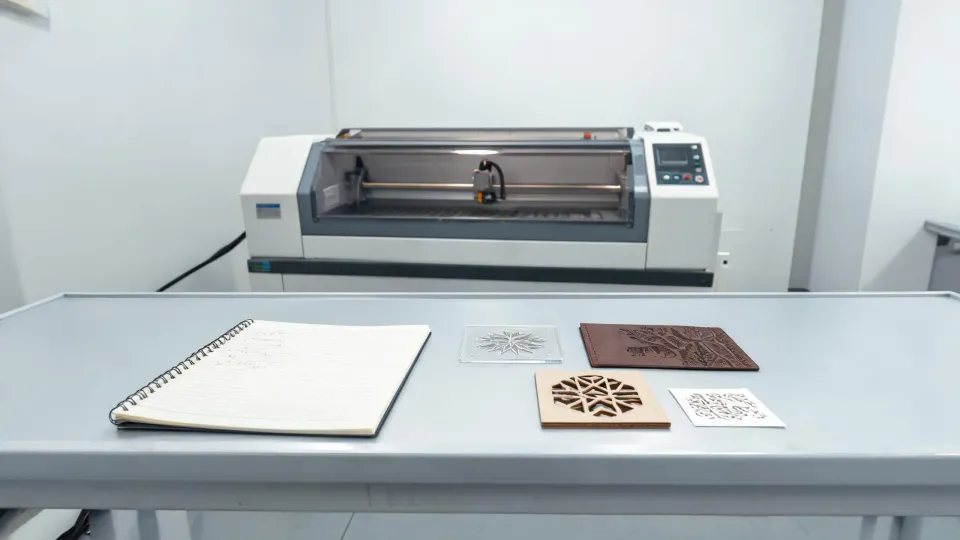
Last October, our vice president walked into my office, dropped a stainless steel nameplate on my desk, and said: “We might make three hundred of these every week. Quote me on a 5x10 fiber laser.” That is how procurement requests usually start in my world—not with a clean specification, but with a solution that someone already heard about and a budget that hasn’t really been defined.
I should be clear about who is telling this story. I’m the buyer for a 45-person metal fabrication company. Since 2020, I’ve handled most of our purchasing, supplier contracts, and vendor relationships. I understand material costs, freight damage claims, and why paperwork matters to the finance team. I did not understand lasers beyond knowing that you do not look at the beam. That turned out to be a problem.
So I did what I always do first: I went down a search rabbit hole. My search history included “used Boss Laser for sale,” “fiber laser class,” “5x10 fiber laser,” and “40 watt fiber laser.” I typed all four because I honestly wasn’t sure which one applied to our project. That messy search trail turned out to be the most useful thing I did all month.
Why I Started With Boss Laser
Boss Laser kept showing up in forums, support threads, and how-to videos. I quickly found their manual library. I even looked up “lens replacement boss laser” before we owned any Boss Laser machine. That wasn’t as strange as it sounds. If we were going to buy a used machine, I wanted to know that routine parts like lenses could be purchased without an expensive service visit from whoever happened to be selling the unit.
After reading through the lens replacement guide, I called Boss Laser with a vague question about parts availability. The support person asked me two questions I wasn’t ready for: “What materials are you marking?” and “What is the daily quantity?” I explained that we needed to put serial numbers and data matrix codes on stainless steel tags. He said something I still think about whenever someone gives me a confident equipment recommendation:
“If all you need to do is mark metal tags, you probably don’t want a used 5x10 fiber laser table. That’s a cutting machine. A 40 watt fiber laser is the right class of tool for that kind of marking work.”
That sentence annoyed me at first. I had asked about replacement parts, not a sales pitch. But he wasn’t trying to upsell me. If anything, he was steering me away from a bigger, more expensive piece of equipment. He did not say “never buy the larger machine.” He said it was the wrong tool for the job we actually had.
The Temptation of a Used 5x10 Fiber Laser
Still, I didn’t accept one phone call as the final answer. That’s not how I buy anything. I kept looking and found a used industrial laser for sale through a reseller. It was not a Boss Laser machine, but it had been listed in a way that showed up when I searched for “used Boss Laser for sale.” The listing described a 5x10 fiber laser table with a massive cutting area. The asking price was around $34,500. Maybe $36,000—I’d have to check my old notes. Either way, it was far below what the machine would have cost new.
The salesperson said the machine could cut sheet metal, engrave stainless steel, mark serial numbers, and handle future work we hadn’t even thought of yet. That sounded impressive. My vice president liked it because it seemed like more capability for less money. On paper, it made sense. But I could not get a straight answer to my technical questions.
When I asked about the laser class rating, he said: “It’s an industrial laser. They’re all class four. That’s normal.” When I asked about manufacturer documentation, he said he could provide it “after the sale.” When I asked about replacement lenses and focus optics, he said those parts were easy to find. When I asked for part numbers, he said he would check and call me back. He never called back.
I went back and forth for about two weeks. The used 5x10 fiber laser promised flexibility. The 40 watt fiber laser from Boss Laser promised fewer surprises. The numbers in a spreadsheet pointed one way, but my gut pointed the other. Deep down, I knew the reseller wasn’t going to be there six months later when the machine needed calibration or a replacement focus lens.
The moment that changed my mind was when I realized I was comparing the wrong things. A 5x10 fiber laser is not a “bigger version” of a 40 watt fiber laser. It’s a different tool. One cuts large sheets of metal. The other marks parts. The first one sounded more impressive, but our production floor didn’t need to cut 5x10 sheets. We needed to mark a stainless steel tag that I could hold in my palm.
What “Fiber Laser Class” Actually Means
The phrase “fiber laser class” was one of my original searches, and it deserves a clearer answer than the used equipment reseller gave me. In the United States, laser products are classified by hazard level, not by wattage or brand. According to the U.S. Food and Drug Administration’s Center for Devices and Radiological Health (fda.gov, 21 CFR 1040.10), laser classes run from Class 1 through Class 4. A bare high-power fiber laser source is typically Class 4, which means the beam can cause serious eye and skin injury if accessed directly. But the same laser source installed inside a properly engineered enclosure with interlocks can be certified as a Class 1 or Class 2 product while operating normally.
That distinction matters more than many first-time buyers realize. When someone asks “what class is this fiber laser?” they are usually asking about safety and regulatory compliance. The manufacturer should provide a class label, testing documentation, and user instructions. The reseller I spoke with could not produce any of that. For our insurance and our operations team, that was a deal-breaker.
I also realized the missing documentation was not the only hidden cost. Moving a used 5x10 fiber laser would have required freight, rigging, electrical upgrades, a controlled laser area if the enclosure wasn’t complete, spare optics, calibration after transport, and training for our team. The $34,500 asking price was only the beginning. By the time I listed everything we would have needed, the so-called bargain looked more expensive than buying a new machine from a manufacturer that could answer a phone call.
What We Actually Bought
We ended up buying a Boss Laser 40 watt fiber laser system with an interlocked enclosure. I won’t pretend it was the cheapest quote we received. It wasn’t. But the process was completely different. They answered technical questions before the purchase. They described the laser class and safety features in writing. They confirmed that replacement focus lenses and parts would be available. Their support person even repeated the same honest message from the first phone call: for large-scale metal cutting, there are better machines. He did not try to convince us that our small marking system could do something it wasn’t designed to do.
That kind of honesty is rare. I have bought enough office supplies, packaging, and production equipment to know that most vendors want to say “yes” to every request. The supplier who says “this is outside my specialty” or “you don’t need the larger model” is the one I trust with the next order.
The 40 watt fiber laser arrived in January 2025. It marks the stainless steel tags we were asked to produce, and it does it quickly enough to handle the volume we project this year. It has a small marking area compared to the 5x10 table, but our parts are small. It also doesn’t require a new electrical service or a dedicated laser room. Our floor manager trained on it in less than a day. A few weeks later, I ordered a backup lens and some cleaning supplies from Boss Laser without any confusion about part numbers. That probably sounds boring, but for someone in my position, boring is exactly the goal.
Do I think used industrial lasers are always a bad idea? No. I think they can be excellent for the right shop with the right experience, the right safety controls, and the right documentation. I also think there is a difference between buying a tool because it is versatile and buying a tool because it fits your actual work. In our case, the used 5x10 fiber laser did not fit. It was a good machine for someone else.
Lessons From a Non-Engineer Buyer
If you are in a similar position and your background is procurement rather than laser engineering, here is what I would tell you:
- Ask about laser class early. The term “fiber laser class” is not about whether one machine is better than another. It is about safety classification, accessible radiation, and enclosure design. Ask for the manufacturer’s class label and documentation before you talk price.
- Search for replacement parts before you search for the machine. Looking up “lens replacement boss laser” before making a purchase taught me more than reading another brochure. If the seller cannot name the correct lens or focus optic for the machine they are selling, walk away.
- Do not confuse a 5x10 fiber laser with a 40 watt fiber laser. Both may use fiber laser technology, but they are built for different jobs. Bigger is not better when it means bigger risk, bigger installation costs, and bigger support gaps.
At the end of the day, I’m not a laser expert. I’m a buyer who has been burned by suppliers that promise everything. The company that said “this smaller machine is the right tool for your needs” earned my trust because it told me something it could have easily left unsaid. That is the kind of supplier I want when my name is on the purchase order.