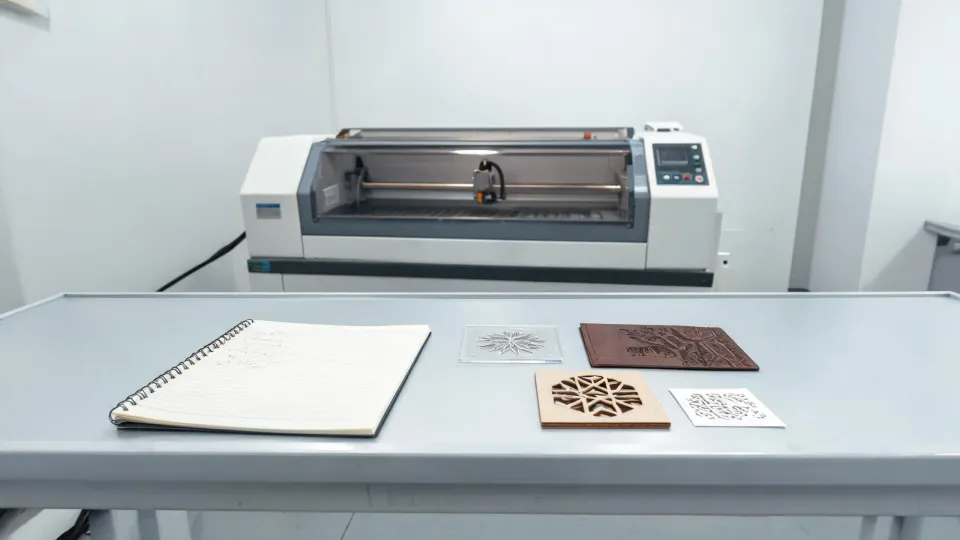
January 17, 2024. Nine degrees outside our New England shop. I had three quotes for a second laser cutter open on my screen, and I was trying to justify the cheapest one to stay under a $48,000 capital budget.
I'm the procurement manager at a 62-person signage and custom furniture company. I've owned roughly $1.1M in annual equipment spend for the past five years—40-odd capital purchase orders, hundreds of small consumable orders. Supposedly, I'd seen every procurement trick. This time, I almost missed a line item I'd never seriously priced out before: replacement lenses.
Three Quotes, One Yellow Flag
By the second week of January, I'd narrowed the field through searches like "boss laser for sale" and a few phone calls with regional distributors. Here's what came back:
- Vendor A — 40W CO2 desktop unit. $18,400, machine only. Freight, install, and training were all quoted separately.
- Vendor B — 60W CO2 floor model. $26,900, freight and install included, training extra.
- Vendor C (Boss Laser) — 55W CO2. $29,750, with freight, on-site install, two days of operator training, and a lens replacement kit included.
On my unit-price spreadsheet, the ranking was clean: A, B, C.
Then Jordan, the procurement analyst we'd hired in 2023, asked a question I still think about. She said: "How many lenses does the cheap one go through in a year?"
I didn't have an answer.
What We Found in the Maintenance Log
I asked Jordan to pull the service history on our first CO2 machine—a $16,800 unit we bought back in 2019 (not a Boss, for what it's worth). Over five years, we replaced lenses roughly every 14 months. Sometimes it was faster: once during a run of recycled HDPE board, a lens degraded in nine days.
The lens itself? About $185. Cheap, in isolation.
But the surrounding costs weren't. Every swap added 4-6 hours of downtime, a re-calibration pass, and a re-test on the material we were running that week. And when you run 18-hour production days for custom signage clients, a lens failure doesn't just cost the part—it costs the slot for the next job that's already been promised.
We valued a production hour at roughly $140 (a blended figure from our shop's billing history, not a textbook number). Four to six hours of unplanned downtime worked out to $560-840 per event. Once a year, minimum. Often more.
The Real Comparison
Jordan rebuilt the spreadsheet with a TCO lens (i.e., total cost of ownership, not just the number on the invoice). Here's what 12 months actually looked like:
Vendor A — Year-One TCO
- Machine: $18,400
- Freight and import duties: $1,980
- Off-site training (2 days, two operators): $1,400
- First-year lens set (assumes 1 replacement on our historical cadence): $740
- Quarterly calibration support: $480
- Projected unplanned downtime: $4,400 (conservative, based on our own logs)
Total: approximately $27,400
Vendor C (Boss Laser) — Year-One TCO
- Machine, freight, installation: $29,750
- Lens replacement kit: included
- Operator training: included, on-site
- First-year service: included
- Projected unplanned downtime (Year 1): $0
Total: approximately $29,750
The gap was $2,350. Not $11,350. That number—the one I'd been staring at for a week—was a spreadsheet artifact caused by comparing price tags instead of costs.
We chose Boss Laser.
Thirteen Months Later
Here's where the story gets interesting, and not in the way I expected.
In February 2025, we ran a batch of recycled HDPE panels. Recycled plastic carries impurities that scatter the beam unevenly (a fact we knew, but underweighted in our schedule). By week two, one of the Boss lenses had degraded enough to throw off depth consistency across the sheet.
We swapped it. The replacement kit had four lenses. Out-of-pocket cost: $0.
Downtime: about two hours, including recalibration. That's it.
If we'd gone with Vendor A, the scenario would've looked different. No spare lens on-site. A 3-5 day shipping window we couldn't compress. And a $3,100 client order that would've been late (again—unfortunately we'd already had one delivery slip that quarter). One $185 part would have turned into an apology, a discount, and a hit to a relationship we'd spent three years building.
There's something satisfying about owning the failure risk instead of renting it. After years of "ship and hope," watching a $185 consumable fail during a run—and knowing it wasn't a crisis—felt like a small, quiet win.
The Old Thinking That Nearly Cost Us
The idea that "cheap machines run the same as expensive ones, just without the badge" was true about 10 years ago, when most entry-level laser systems really did share similar tube and lens components. That's changed.
Today the differentiators live in places you can't see on a spec sheet: lens coating quality, power supply stability, software update cadence, and whether a service tech can reach you in 24 hours or two weeks. Those things don't matter the day the machine arrives. They matter the night it fails on a deadline order.
For what it's worth, the physics hasn't changed. CO2 lasers run at a 10.6 μm wavelength, which is what lets them cut and engrave organics efficiently—wood, acrylic, leather, glass. Fiber lasers run closer to 1.07 μm and are the right tool for metals. This is exactly the kind of distinction that gets flattened into search queries like "co2 laser treatment before after," which—fair warning—usually pulls up dermatology clinics, not manufacturing equipment. Different world entirely.
What I'd Tell Another Procurement Manager
Three things.
One: Price out the consumables before you price out the machine. Lenses, nozzles, focus tips, and protective windows on a cutting machine laser are wear parts, not spare parts. Vendors who quote them low often have a markup waiting three months later. Vendors who bundle them are usually telling you something about their support model.
Two: Ask where the service tech lives. In 2020, the fiber laser USA market was thin—mostly importers with remote-only support. As of 2025, at least a handful of suppliers run genuine domestic field teams. We're now evaluating a fiber unit for metal work in Q3, and the first question on my list is response time, not wattage.
Three: Redo the math with downtime baked in. Nothing on a quote sheet tells you what a failure costs at 11pm on a Thursday with a Friday client delivery. That number lives in your own maintenance log, not the vendor's brochure.
The Number That Actually Mattered
The at-purchase TCO difference between the cheapest quote and the Boss Laser quote was $2,350. After Year 1, it narrowed to about $900. By Year 2—with the bundled lens kit still unexhausted and zero unplanned lens-related downtime—it flipped in our favor.
If you're comparing quotes right now, ask each vendor three questions before you sign anything:
- How many replacement lenses, focus lenses, or protective windows are included, and at what cadence should we expect to replace them?
- Who trains our operators, where, and how many hours?
- What's the guaranteed response time if the machine fails during a production run?
The lowest price on a laser purchase is just the first entry on the cost curve. The curve itself is what you're actually buying.
Prices referenced are from our own 2024 procurement files. Verify current rates with any supplier before quoting; equipment pricing varies significantly by configuration, region, and time of order.