-
Who This Checklist Is For
-
Step 1: Nail Down Your Material & Application First
-
Step 2: Calculate Total Cost of Ownership, Not Just the Sticker Price
-
Step 3: Verify After-Sales Support Before You Sign Anything
-
Step 4: Run Sample Tests—Don't Skip This
-
Step 5: Plan for Urgency—Delivery Certainty Has a Price
-
Common Mistakes to Avoid
Who This Checklist Is For
If you're the person in your company tasked with sourcing a laser cutting or engraving machine—whether it's a CO₂ laser for acrylic signage, a fiber laser for metal marking, or a hybrid unit for a makerspace—this checklist is for you. I've been managing equipment procurement for a mid-size manufacturing facility since 2020, and I've made enough mistakes to know what actually matters when you compare machines like the Boss Laser LS-series, Omtech, or Thunder Laser.
This isn't a theoretical guide. It's the exact list I follow now, after burning budget on a machine that couldn't hold tolerances and another that had no local support. Five steps, no fluff.
Step 1: Nail Down Your Material & Application First
When I first started shopping for a laser, I assumed power was everything—more watts, better machine. That was wrong. The real starting point is the material mix you'll process and the outcomes you need.
For CO₂ lasers (typically 40W–150W): they handle organics—wood, acrylic, leather, paper, glass, some plastics. If you're engraving tumblers or cutting plywood, CO₂ is your lane. Specific models like the Boss Laser LS-1630 or LS-1420 are common in small manufacturing because of their large work area and reliable tube life.
For fiber lasers (20W–50W+): they mark and cut metals, some plastics, and ceramics. If you're doing serial numbering on steel parts or engraving logos on aluminum, you need fiber. A 50W fiber laser marking machine price in Q4 2024 ranged from $3,500 to $8,000 depending on source and warranty. But price alone doesn't tell you if the galvo head is matched to your field size.
Checklist action: Before you search for "Co2 laser Omaha" or "fiber engraving laser", write down the top three materials you'll run in the first six months, plus required tolerances. Then match laser technology. Skipping this step is the #1 source of buyer's regret.
Step 2: Calculate Total Cost of Ownership, Not Just the Sticker Price
In 2022, I found a machine for 40% less than the equivalent from a known brand. Took the deal. By month four, the laser tube needed replacement ($800), the controller software didn't support our design files, and the "free" support was a WhatsApp group with a 48-hour response time. That $3,000 savings evaporated.
Here's what goes into total cost of ownership (as of January 2025):
- Base machine price
- Shipping & rigging (some vendors don't include crating)
- Laser tube replacement (CO₂ tubes last 2,000–8,000 hours; fiber lasts 50,000+ hours)
- Lens and mirror replacement (CO₂ requires periodic cleaning/replacement)
- Software license or subscription (LightBurn, EZCAD, etc.)
- Chiller maintenance for CO₂ systems
- Training time (if the vendor doesn't provide setup support)
Short version: The cheapest quote is rarely the cheapest total. I've seen colleagues order a Boss Laser cutting machine because the upfront cost was middle-of-the-pack, but the included training and long tube warranty brought the 3-year cost below cheaper competitors. Do the math over 36 months.
Step 3: Verify After-Sales Support Before You Sign Anything
I know—every vendor claims 24/7 support. But when your production line is down because the laser won't fire, "we'll get back to you in a few hours" isn't acceptable. I learned this the hard way when a budget supplier had no North American phone number and the only support person was in a different time zone.
Check these specifics:
- Response time guarantee: Written, not verbal. Many brands like Boss Laser, Omtech, and Thunder Laser have US-based phone support. Call them before you buy—see how long you wait.
- Parts availability: Can you get a replacement tube or board shipped same-day? Some vendors stock common parts regionally. For a fiber engraving laser, the controller board is critical—ask about lead time.
- Remote diagnostics: Do they offer TeamViewer or remote access? This saved us a $500 service call once.
- Return policy & warranty: A 12-month warranty is standard; 24-month is better. Pay attention to what's excluded (laser tubes are often prorated).
Pro tip: Search for "boss-laser" + "troubleshooting"—the depth of community forums tells you real support quality. If you see many unresolved threads, walk away.
Step 4: Run Sample Tests—Don't Skip This
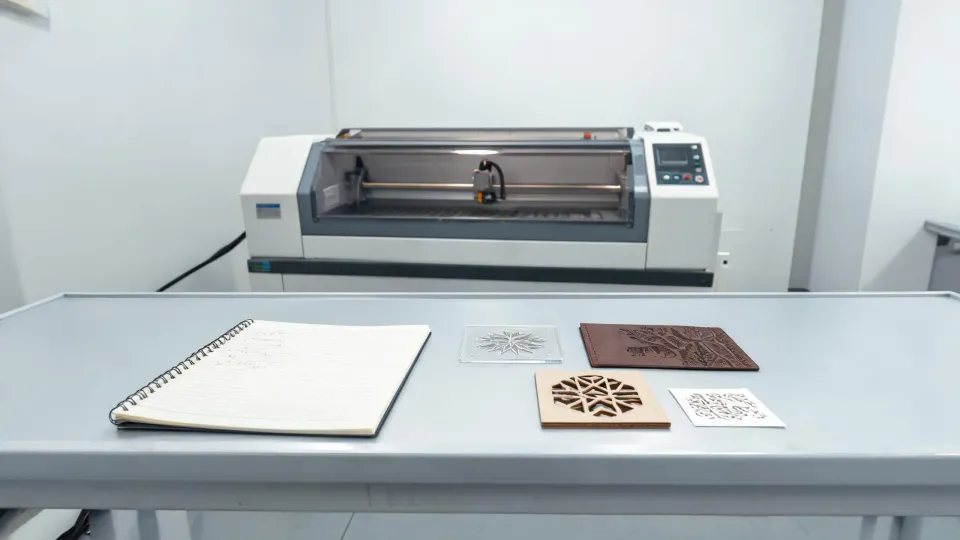
This is the step almost everyone rushes through. "I know what a CO2 laser can do." Well, I once skipped the test cut because the vendor was three weeks out. When the machine arrived, the focal length was misaligned for our 3mm acrylic—we lost a week of production. That's a $2,000 delay on a $6,000 machine.
What to test:
- Send them your actual material (a few sheets of your wood, acrylic, or metal).
- Request test cuts/marks at the speeds you plan to run production.
- Ask for edge quality photos up close—rough edges mean rework.
- Test software compatibility: export from your design tools (Corel, Illustrator, SolidWorks) into their controller software.
Most reputable vendors will do this for free. Some charge a small fee credited toward purchase. If a vendor refuses or offers only "stock samples," that's a red flag. A good Boss Laser logo or any manufacturer's logo means nothing if the machine can't handle your job.
Step 5: Plan for Urgency—Delivery Certainty Has a Price
Here's where the time certainty premium kicks in. In March 2024, we needed a fiber laser urgently for a contract that required marking serial numbers on 2,000 parts by the end of the month. Two vendors gave quotes: one $4,200 with "estimated 3–4 weeks" delivery; another $4,800 with guaranteed 2-week delivery from stock.
I almost went with the cheaper option—same machine specs. Then I remembered the previous year when a "probably on time" shipment cost us a $15,000 order because we missed the deadline. We paid the $600 premium. The machine arrived in 12 days. I didn't lose sleep.
The math is simple: The cost of missing a deadline is almost always higher than the premium for guaranteed delivery. For industrial buyers, when you get the machine can be more important than the price. That's especially true for a 50w fiber laser marking machine price where a delay means lost production revenue.
If you're searching for "co2 laser omaha" or "boss laser cutting machine" because of a specific event or contract, ask every supplier for a written delivery guarantee with a penalty clause. If they won't commit, they don't have stock.
Common Mistakes to Avoid
- Comparing only power: A 60W CO₂ laser from one brand vs. another can differ in beam quality, tube type, and cooling efficiency. Test, don't assume.
- Ignoring exhaust and ventilation: Laser cutting produces fumes. Make sure your facility can handle the CFM requirement.
- Overlooking software training: If your team has never used LightBurn or EZCAD, budget for training days. Some vendors include it.
- Not factoring in consumables: CO₂ lenses and mirrors degrade. Fiber laser diodes eventually degrade. Budget 10% of machine cost annually for consumables.
- Purchasing based on a brand name alone: "Boss laser logo" doesn't guarantee it fits your workflow. Verify the specs against your checklist.
A final thought: The best purchase decision I ever made was the one where I slowed down, ran the tests, and paid for delivery certainty. That's why my current machine—a Boss Laser hybrid CO₂/fiber—has been running daily for 18 months with zero unplanned downtime. It wasn't the cheapest option. But it was the most reliable. And for an industrial buyer, reliable beats cheap every time.