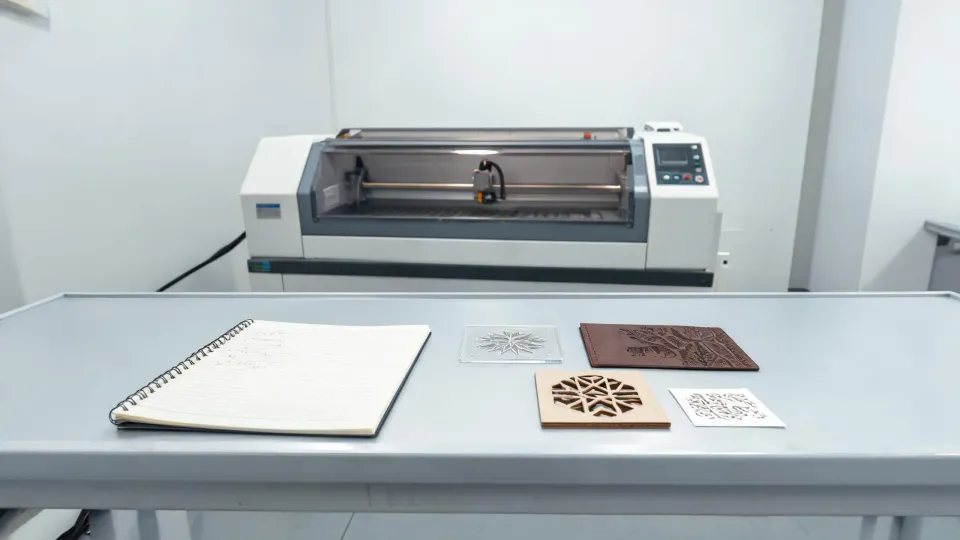
I still remember the day I ran the real numbers on our laser equipment. Not the invoice totals. The actual cost—with scrapped material, rework hours, emergency service calls, and operator mistakes folded in.
I stared at the spreadsheet for a long time. Then I closed it and went for a walk.
I've been tracking every laser-related expense since 2019. Six years of purchase orders, service tickets, material waste logs, and training hours. When I reconciled everything, the total was around $180,000. Maybe $175,000, I'd have to re-run the final quarter.
The machine you buy matters less than how you buy it.
The Problem Everyone Fixates On: Specs
Every time another procurement person finds out I manage laser equipment, the question is the same: "Which machine did you go with?" They want a brand, a model, a wattage rating. They're building a comparison matrix, color-coded, sorted by engraving area and maximum cutting speed.
I get it. I was that person. I spent a month comparing spec sheets before our first purchase. Three weeks, maybe. It felt like a month.
I knew the difference between a 40W and 100W CO2 tube. I knew a fiber laser could mark bare metal while a CO2 laser couldn't reliably. I had strong opinions about cooling systems.
None of that prepared me for what happened after the machine arrived.
The Real Problem: What Happens After the Crate Opens
Here's what the purchase order doesn't tell you: the machine is roughly a third of the five-year cost. The rest goes to things no spec sheet will ever list.
1. Untested Materials Will Burn Your Budget
Every new material is a gamble until you've dialed in the settings. Wood density varies by species and supplier. Acrylic comes in different formulations that absorb laser energy differently. Coated metals—the whole point of a fiber laser for many shops—can behave completely differently depending on coating chemistry.
I learned this the hard way. We got a contract to engrave anodized aluminum nameplates. The coating looked uniform. Our settings matched the material profile we'd found online. First production batch of 200 pieces? Washed out. Inconsistent marks across the entire run.
We'd skipped the material test to hit the deadline. Twenty minutes of verification would have caught it.
That decision ended up costing us about $4,200: $1,400 in scrapped material and $2,800 in overtime rework. The worst part? The client was understanding. The second run went fine. But the $4,200 was gone, and it was entirely preventable.
This is where I'll credit one specific vendor behavior. When we were evaluating Boss Laser, we asked if they had material data for the specific anodized aluminum we were using. They didn't just say yes. They showed us a test matrix from their own lab and offered to run samples from our supplier. The Boss Laser materials library isn't a marketing page—it's an actual reference we still use for starting parameters on new materials.
That's the difference between a vendor that treats material testing as a checkbox and one that treats it as part of the product.
2. "Surgical Precision" Is Not a Marketing Phrase
I used to roll my eyes at the phrase "surgical precision." Everyone claims it. Nobody defines it.
Then we took on a medical-device client who needed markings on surgical instruments for traceability. Suddenly, precision was a contractual requirement, backed by a quality management system. The marks had to be legible at a specified character height, consistent within a defined tolerance, and readable after hundreds of sterilization cycles.
That project taught me what surgical laser fiber capability actually means in practice. When a medical OEM asks about surgical laser fiber marking, they're not asking about power. They're asking whether your beam quality, focus stability, and machine consistency can hold a legible mark across thousands of identical parts. Under an ISO quality system, the machine's repeatability has a direct dollar value—because every failed batch is a documented non-conformance that costs far beyond the scrap.
That's when I stopped buying machines by wattage and started buying them by repeatability.
3. Autofocus Should Be Non-Negotiable
We almost skipped autofocus on our second machine. It looked like a nice-to-have, a convenience feature for operators who didn't want to measure focus distance by hand.
Turns out, manual focusing errors are not "close enough." They're scrap parts. A focus error that's tiny on flat acrylic is a disaster on an uneven metal surface or a curved part. And the way it shows up is insidious: the first piece looks fine, then heat buildup shifts the focal plane over the run, and by piece three hundred, quality is gone.
Why does this matter for procurement? Because the autofocus fiber laser option we eventually got on our third machine eliminated an entire class of operator errors. It turned focus from a skill into a setting. That's not convenience—that's process stability. And process stability has a measurable return. That machine has run for three years with under $900 in unplanned costs. The previous one sat closer to $4,000 per year in reburns and troubleshooting.
4. Fiber Cable Management Is the Hidden Detail You'll Regret Ignoring
Here's a story that still makes me wince.
Our second year with the fiber marking station: the machine starts producing progressively worse marks. We check the lens, the nozzle, the air pressure. Clean everything. Still bad. We call support. They suggest cleaning the fiber end face. No improvement. Eventually, they ask us to send the fiber cable in for inspection.
Diagnosis: internal bend damage, likely from cable strain at the rack connection point. The fiber had been slowly degrading over months of normal use because it was routed with too tight a bend radius and no strain relief.
Replacement cost: $1,150. Plus shipping. Plus three production days lost while we waited for the part.
(Should mention: that's also when I started noticing how laser systems manage their fiber optics. When we later upgraded, one reason we chose Boss Laser was the design detail in their optical fiber tray for laser system rack configurations—it's a patented component, and it's the kind of mundane thing reviewers never mention. The fiber is properly guided with controlled bend radius and restraint. It's engineered by people who clearly saw the same failure mode I did.)
That's the stuff that never appears in marketing videos. It shows up in month nine of ownership.
What Ignoring These Factors Actually Cost Us
Let me put a number on it. In the first two years, before we had proper verification protocols:
- $8,400 in scrapped material across four major incidents
- $6,700 in rework labor covering jobs that failed final QA
- $4,300 in emergency service fees—three of which routine checks would have caught
- $1,150 for that fiber cable replacement
That's $20,550. On a machine that cost $18,000 new.
We had technically lost money in the first two years of ownership. And the machine itself was fine. The failures were all buyer-side.
I still kick myself for that period. If I'd implemented even a basic pre-flight checklist from day one, we'd have avoided at least half of that.
So What Changed? Verification Before Acquisition
After the anodized aluminum incident, I built a procurement checklist and made it our policy. It's not complicated, and I'll share the parts that actually matter.
Test Before You Trust
Demand material tests on your materials, not the vendor's favorites. If a vendor won't run samples on three materials you actually use—and document the settings—that's a disqualifying signal. We got Boss Laser to test our substrates before we signed. It took a week. It was the best week we ever spent on procurement.
Calculate TCO, Not Invoice Price
Our policy now requires quotes from three vendors minimum on same-scope specifications, and we use a total cost of ownership spreadsheet that includes:
- Shipping, rigging, and installation
- Consumables and expected life (tube, lenses, nozzles, focus rings)
- Calibration and maintenance frequency
- Service response commitments—and the financial impact of downtime while waiting
- Software costs that aren't a subscription trap
When people ask me about a boss laser engraving metal application, they always compare watts. I tell them the same thing: watts are table stakes. What matters is whether the machine can hold tolerance at production speed on your material. A machine that engraves metal at a 95% pass rate is a different investment than one at 99.5%—the difference shows up in rework labor, not on the invoice.
Make Checklists Non-Negotiable
5 minutes of verification beats 5 days of correction. That's not an aphorism—it's arithmetic. Our pre-flight checklist takes six minutes and has caught issues that would have cost an estimated $8,000 in potential rework. It's the cheapest insurance I've ever put in place.
The Bottom Line
I can only speak to my context: mid-size B2B manufacturing, predictable order flow, and a small but busy laser lab. If you're a hobbyist with a desktop diode laser, or a massive fabrication shop with a full-time laser tech, your numbers will look different. The principles don't.
Here's the thing I've come to believe after all these years and all these dollars: most laser machine "failures" are actually verification failures. Someone didn't test the material. Someone didn't check the focus. Someone didn't inspect the cable routing. Someone didn't calculate what the warranty actually covers.
The machine is rarely the villain.
Skip the test. Pay later. That's the true formula.
Or spend six minutes. Your choice.