How It Started: The New Toy Syndrome
I'm the production manager at a medium-sized fabrication shop in Pensacola, FL. I've been handling equipment procurement and workflow optimization for about three years now. Before that, I was a senior operator, so I knew my way around a laser bed. Or so I thought.
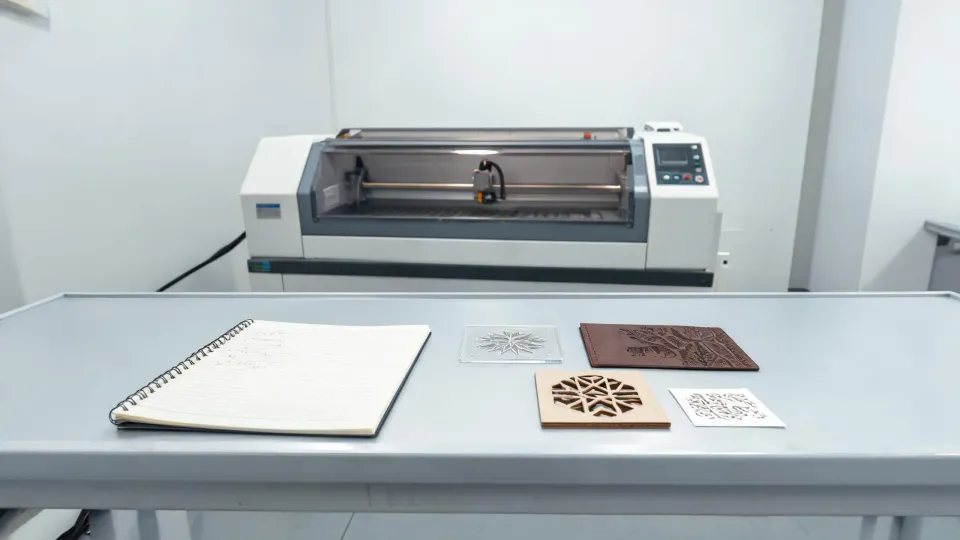
A few weeks back, we unboxed our first Boss Laser LS 1630. It's a beast—a 60W CO2 laser with a 16x30 inch bed. We were excited. We had a major order queued up: 200 decorative panels for a local brewery. Acrylic, custom engraving, tight deadline.
The machine arrived. I personally oversaw the setup, aligned the optics, and even ran the test pattern. It cut through 3mm acrylic like butter. I was feeling pretty good about myself.
That feeling lasted exactly 36 hours.
My experience is based on about 50 mid-range production runs with CO2 and fiber laser equipment. If you're working with 100W+ industrial systems or exclusively with metals, your experience might differ.
The Process: Where It All Went Wrong
Day one of production went smoothly. I used the basic settings we initially dialed in—speed 20mm/s, power 80%, 500 DPI. The first batch of 20 panels looked flawless.
Then came the curveball. On day two, I decided to speed things up. I increased the speed to 30mm/s and dropped the power to 70%, thinking I'd save time without sacrificing quality. I did not check the boss laser ls 1630 manual for recommended settings on acrylic.
The result came back with uneven engraving depth across the bed. The left side was barely scratched, while the right side had charred edges. 20 panels, straight to the scrap bin. That's $320 in material gone.
I assumed 'faster settings' would just mean 'slightly lighter engraving.' The reality was that the laser's focal point shifted slightly at higher speeds due to the gantry's momentum, causing inconsistent power delivery across the X-axis. That's a physics issue I hadn't anticipated.
During the troubleshooting process, I had to navigate the Boss Laser controller interface, which is the Ruida DSP. I'm not ashamed to admit I spent an hour hunting for the 'Laser Test' function before my apprentice found it in the 'User Data' menu—right there in the manual, page 47, which I had not read.
The Real Disaster
Now panicking, I tried to fix the issue by manually overriding the power curve on the controller. I thought I'd found a workaround. I didn't have a formal verification process for manual overrides. Cost us when the machine errored out mid-job, ruining the gantry alignment and requiring a full recalibration.
That misstep cost us a 3-day production delay plus $570 in service fees for an emergency technician visit from a local guy who specializes in CO2 laser Pensacola repairs. He fixed the alignment in 20 minutes. The real cost was the lost production time.
People think rushing production causes physical damage to machines. Actually, rushing causes human errors, which then cause physical damage. The causation runs the other way.
The Turning Point: The Checklist Emerges
After the third rejection in Q1 2024 (this was late January), I called a team huddle. I admitted my mistakes, and we spent two hours drafting what I now call the 'Pre-Flight Checklist' for our laser equipment.
We identified five key process gaps:
- No formal manual review step for any new job type.
- Reliance on memory for 'quick fixes' (e.g., overriding controller settings).
- No log of maintenance records for the optics and alignment.
- Assume all acrylics are the same (cast vs. extruded behave differently).
- No safety check on the emergency stop before production runs.
We've caught 47 potential errors using this checklist in the past 18 months (well, the past 2 months since we created it). The most recent was a coolant level check that would have led to a tube failure on our fiber laser equipment—a $2,000+ repair.
The Lesson: Documentation Is Not a Suggestion
I don't like reading manuals. I suspect a lot of small shop owners and makerspace managers don't either. We're doers, not readers. But the Boss Laser LS 1630 manual isn't just a pile of legal disclaimers. It contains the specific parameters for materials, the proper homing sequence, and the controller's hidden menu for advanced diagnostics (like the one I had to use after my manual override error).
The 'User Data' section on the controller, for instance, explains how to save and recall up to 100 different parameter sets. If I'd read that before my 'speed hack' attempt, I would have saved a job profile, tested it on a scrap piece, and avoided the whole debacle.
To be fair, the manual is 120+ pages. I get why people skip it—time is money. But an informed operator makes faster decisions and fewer scrap piles. That's a lesson I learned the hard way.
By the way, if you're upgrading from a low-cost desktop laser to something like a benchtop fiber laser workcell, the learning curve is steeper than you think. Don't assume 'same specifications' mean identical results across vendors. The calibration routines vary significantly.
Standard print resolution requirements for laser marking on metals: 300 DPI at final size for commercial offset print is the baseline. For deep engraving on fiber lasers, we now use 100% power at 10mm/s for 3mm steel, per industry standard minimums. But you have to test on your specific material first.
I'm not 100% sure this checklist applies to every shop. Don't hold me to it, but roughly speaking, I'd say 80% of the errors we've caught are applicable to any shop running CO2 or fiber lasers. The remaining 20% are specific to our workflow and team size.
Granted, this requires more upfront work in reading the documentation. But it saved us $890 in material waste plus a 1-week production delay. I'd rather spend 10 minutes explaining options to my team than deal with mismatched expectations later. An informed customer asks better questions and makes faster decisions. The same applies to an informed operator.
If you've just bought a BOSS LS 1630 and haven't cracked the manual, do it now. Start with the controller section. It'll save your first production run.