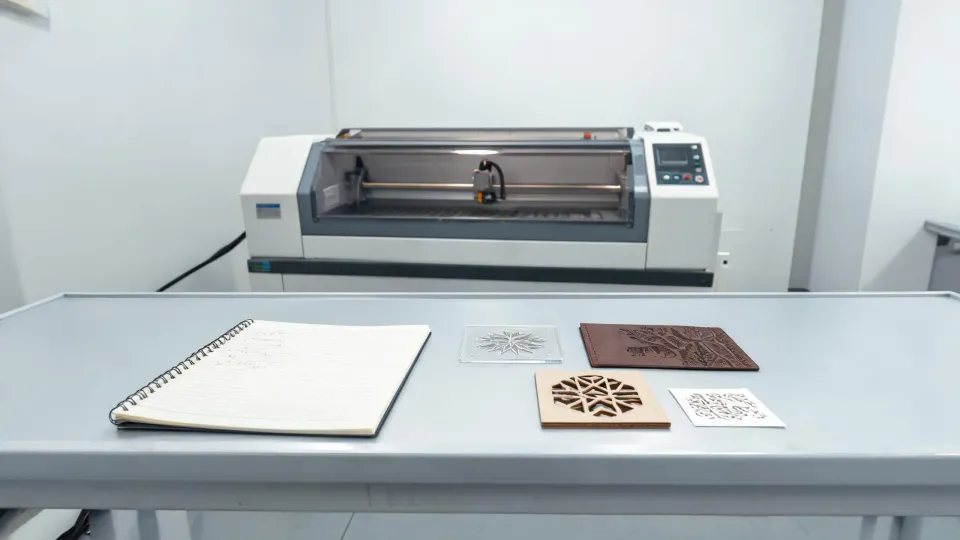
It was 9:47 on a Tuesday morning in March 2023 when I heard glass piece number seven crack clean in half on my BOSS LS-1630. That sound—a sharp ping followed by a split-second of silence—stays with you. I stopped the job at twelve pieces, swept up the mess, and did the math. $320 worth of glass in the trash. Forty minutes of machine time wasted. And a distillery order that needed to ship in five days.
How I Got Here
I bought my BOSS LS-1630 CO2 laser two years before that morning. Wood, acrylic, leather—that was the plan. Glass etching was on my mental list of "someday projects," the kind of thing you say you'll learn and then don't. Then a local distillery asked if I could engrave 200 tasting glasses with their logo. I said yes without testing a single piece of their glassware. That was mistake number one.
I'd like to tell you it was an isolated lapse of judgment. It wasn't. It was classic beginner overconfidence: I'd done a few successful glass etches, so I assumed I knew the material. Glass is glass, right?
Glass Is Not Glass
Here's what I learned the expensive way: soda-lime glass, borosilicate, leaded crystal, and recycled-content glass all absorb CO2 laser energy differently. My first test piece was soda-lime from a restaurant supply store. The distillery's tumblers were recycled-content glass with noticeably different thermal behavior. Same material family, completely different reaction to the laser.
CO2 lasers etch glass through thermal shock. The laser heats a microscopic area of the surface extremely fast, and that rapid temperature change creates micro-fractures that scatter light and give the frosted appearance. But the difference between "clean frost" and "shattered glass" is a matter of a few percentage points of power. Too much power, or too slow a speed, and the thermal stress overcomes the glass. Crack.
That Tuesday, I ran the exact settings that had worked on my test glass: 38% power, 120 mm/s, 500 LPI. Great results on the cheap tester. Catastrophic on the distillery's glass. Every piece cracked within seconds of the beam hitting the surface.
My next week turned into an unplanned research project. I burned through more test pieces than I want to admit, trying different power levels, speeds, and pass counts. What finally produced a clean frost without fractures was lower power than I expected—28% on my 80W tube—with three passes at 150 mm/s. And for some glass types, I used a slightly damp paper towel pressed flat against the surface to absorb heat. That technique is legitimately useful; it redistributes thermal stress across the surface. But it only works if your base settings are already dialed in.
I only fully believed that advice—"always test before committing to an order"—after it cost me a month of profit. That's the reverse-validation curse. We all want to learn from other people's mistakes. Most of us end up paying our own tuition.
The Fiber Laser Detour
About four months after the glass disaster, I convinced myself I needed a fiber laser. The logic felt airtight: if a CO2 laser handles non-metals and a fiber laser handles metals, then owning both means I can say yes to any job.
Wrong. Not "sort of wrong." Wrong for glass.
Fiber lasers operate at 1064nm, a wavelength that passes straight through transparent glass without leaving a mark. My MaxPhotonics 50W fiber laser is genuinely excellent at what it was designed for—dark, permanent marks on stainless steel and aluminum—but it cannot etch glass.
Even after the fiber laser arrived, I kept second-guessing. What if I just hadn't configured it right? What if there was a setting that would make it work on glass? I spent two weeks tweaking every variable before finally accepting that the wavelength itself was the problem. No amount of adjust-focus-power-speed gets around physics.
That purchase was impulsive, and I'm not proud of how I justified it. But I've learned to respect what each machine class actually does. For cutting laser CO2 jobs—wood, acrylic, glass etching—the CO2 laser is the right workhorse. For metal marking, fiber laser technology like MaxPhotonics is the right tool. They coexist. They don't substitute.
Black Friday and Honest Shopping Advice
A few months later—October, actually—BOSS Laser's Black Friday promotion popped up. Their deals are legitimately decent: I've seen 10-15% off machines and accessories, with bundle pricing on the CO2 lineup. I bought the rotary attachment for my LS-1630 at a discount, and that purchase paid for itself within two jobs because it lets me rotate tumblers for continuous etching around curved surfaces.
But here's the honest part, and it applies to any boss laser black friday deal or any big sale in this industry: a discount doesn't make the wrong machine right. Fifteen percent off something you'll use twice a year is still a bad investment. I've watched hobbyists jump on "deal of the year" marketing and end up with a machine collecting dust. And I've seen beginners buy a diode laser thinking it would handle glass before realizing it's too weak for production glass etching.
If you're shopping, my unsolicited advice is this:
- Decide which materials will make up 80% of your actual work.
- Match the laser wavelength to those materials, not just the brand.
- Then find a sale on that machine.
Portable Laser Welding: A Candid Take
People also ask me about portable laser welding machine reviews more than I expected. I've tested BOSS Laser's handheld fiber laser welding unit, so here's my practical take.
The machine is impressive in person. It welds stainless steel and straight aluminum with clean, consistent seams and a heat-affected zone that's drastically smaller than TIG welding. For sheet metal repairs and stainless fabrication, it's a serious production tool, and the learning curve is gentler than traditional welding because the machine handles a lot of the fine control automatically.
Now the candid part: I do not recommend this for small shops with occasional welding needs. A portable laser welder is specialized industrial equipment, and the price reflects that—we're talking five figures for most setups. If you're a one-person shop and someone hands you a cracked aluminum bracket twice a year, subcontract that work. Buying a laser welder for that workflow is the same mistake I made with the fiber laser: great tool, wrong scenario.
That's not a criticism of the product. It's a question of fit.
What I'd Do Differently
If you take nothing else from this article, take these three rules. They're printed on a card in my shop now, right next to the laser interlock switch.
Rule #1: Never run a production batch on a glass type you haven't tested.
Rule #2: Document every setting that works. You'll need it again.
Rule #3: The best machine is the one matched to your actual workflow.
The documentation habit is the one I wish I'd started on day one. I keep a binder with test results for every material I've run—settings, photos, notes on what failed and why. Since 2022, I've logged over forty documented test runs on glass alone. That binder has saved me thousands of dollars. It'll do the same for you if you start one.
For glass etching specifically, a CO2 laser is the right class of tool. BOSS Laser's LS series has served me well, and the company's support and community are real advantages—that's not marketing talk, that's my experience with three years of ownership. But regardless of brand, commit to testing. Different glasses behave differently, and even the same model from the same supplier can vary between production runs.
For metal marking, fiber lasers like the MaxPhotonics line are the right call—but only if you have consistent metal work. If you don't, a local job shop is cheaper than owning a machine.
For welding, don't buy portable laser welding equipment unless you have the volume to justify it.
There's also a marketing side to this that I learned when I started selling etched glass commercially. Per FTC guidelines (ftc.gov), advertising claims need to be truthful and substantiated. I can say "etched with a CO2 laser" because that's verifiable. I can't say "will never fade" or "unbreakable" without testing and evidence. So I don't. That discipline has made my customers trust me more, which is honestly the whole ballgame.
And when it comes to shipping samples and quotes, budget realistically. A standard letter in a #10 envelope costs $0.73 to mail as of the USPS January 2025 rate adjustment. But glassware doesn't ship in an envelope. Proper packaging and shipping is a real line item—plan for it.
What I Hope You Take From This
I've been running BOSS Laser equipment for three years, and the glass etching side has grown into a steady revenue stream. But the path included wasted glass, a fiber laser I didn't need, and plenty of hours I'll never get back. I'd rather you skip those parts.
Test your materials. Keep records. Match the tool to the job. And if someone tells you their machine is best for everything, they're not doing you any favors.
The right question is never "which laser is the best?" It's "which laser is best for the work I actually do?" The answer, more often than you'd think, is a CO2 laser with a little patience and a notebook.