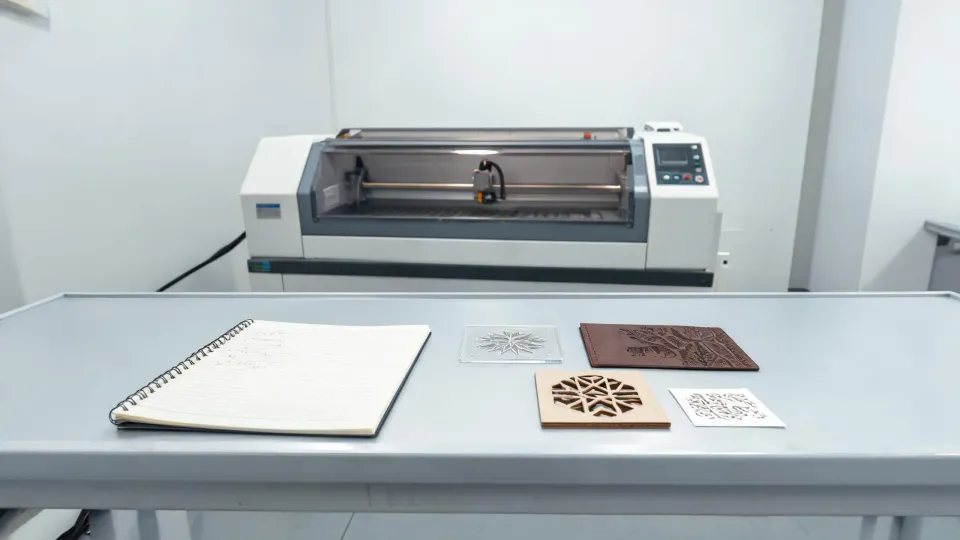
You've got a laser machine humming in the corner. This morning it ran a job so clean you wanted to frame it. This afternoon, the edges look like they were cut with a rusty knife, and the engraving depth is all over the shop. Sound familiar?
The first instinct is almost always the same: I bought the wrong machine. You start second-guessing the brand. You google "omtech vs boss laser" at midnight. You tell yourself that if you'd spent another thousand dollars, your parts would be perfect.
I'm the quality compliance manager at boss-laser. I review every machine that leaves our floor—roughly 400 units a year. In Q1 2024 alone, I rejected 6% of first assemblies for alignment issues. I know what a real hardware defect looks like. And that's exactly why I'm telling you: most laser quality problems aren't hardware problems.
The Surface Problem: It Looks Like a Machine Failure
Here's how a typical warranty claim starts. A customer writes in: "Machine was fine for six weeks. Now the cuts are charred, engraving is inconsistent, and I need a replacement tube." By the time they contact us, they've already planned the fight. They've decided the machine is defective.
I don't blame them. When production stalls and materials pile up in the scrap bin, "defective machine" is the most comfortable explanation. It means it's not your fault, and that's a nice feeling.
But our warranty data says something different.
The Deeper Truth: 71% of "Failures" Are System Issues
We track every warranty claim, return, and field diagnostic. In 2024, 71% of our warranty investigations traced back to one of three things—none of which involved a failed component:
- Contaminated or misaligned optics. Dirty focus lenses, mirrors knocked out of alignment, or a damaged CO2 laser arm assembly from cutting with a failed air assist line. Basically, the optical path isn't being maintained.
- Parameter drift. Speed and power settings moving away from the proven baseline for that material. Different material batches behave differently, and settings don't adjust themselves.
- Software configuration problems. Wrong focal length stored in the library, incorrect axis scaling, or a corrupt setting quietly overriding everything else.
Not one failed tube. Not one dead power supply. Those failures do happen—and we replace them fast—but they're the exception, not the rule.
This was a hard lesson for us internally, too. In November 2022, we received three warranty claims in ten days. Our service team found a dirty lens on the first, a cracked air assist hose on the second, and a loose z-table lock on the third. Not a single defective machine. We'd already shipped two replacements before diagnostics even finished.
That month changed how I think about laser quality. The hardware is rarely the villain. The system around it—maintenance habits, parameter discipline, operator awareness—that's where quality actually lives.
Hardware fails suddenly. Systems drift slowly. And it's the drift that ruins your parts.
I'll say something that might sound harsh, but I mean it with respect: most laser quality problems are operator-side problems. Not because people are careless, but because nobody teaches laser operators how much of the job is system discipline.
The Myth of the "Better Machine"
The "if I spend more, it'll be more consistent" idea comes from an era when CO2 glass tubes were genuinely hit-or-miss. Ten years ago, two tubes from the same supplier could have wildly different power curves. That's mostly gone. Modern CO2 tubes are tested before they ship, and fiber sources are even more stable. The bottleneck has moved. It's the optical path, the parameters, and the people managing them.
Here's the uncomfortable truth: a $6,000 machine with clean optics and disciplined parameters will outperform a $15,000 machine with a dirty lens and guessed settings. Every single time.
What Ignoring This Costs You
Let's put actual numbers on this, because "efficiency" talk is cheap.
A 20" x 24" sheet of 3mm acrylic runs $12–$20 from typical online suppliers, based on publicly listed prices (January 2025). A bad run—charred edges, inconsistent depth—can burn through five to ten sheets before you notice the drift. That's $75–$200 in materials heading to the scrap bin.
Then there's machine time. A medium-detail cut takes 15–40 minutes per sheet. Four wasted sheets at 25 minutes each is nearly two hours of lost production. At $50–$75 per hour—rates quoted publicly in 2024–2025 job-shop pricing—that's another $150–$200 gone. Per bad run.
Now the expensive scenario. If the ruined job was for a customer, you're not just re-running materials. You're reworking a deadline. Rush rework costs more—sometimes a lot more. The worst case I've personally seen was a $22,000 redo at a customer's shop in 2023. The machine didn't fail. A dirty lens sat unnoticed for three weeks, and they kept cutting through it. No maintenance schedule, no parameter log, no verification. I use that number at every site visit.
The cost that compounds silently is this: when you treat these incidents as random machine failures, you never fix the underlying drift. Replace the lens, and it works for a month. Then it degrades again. Your conclusion: this machine is unreliable. The real conclusion: the process is unmanaged.
Consider this: the same CO2 wavelength used in industrial cutters is also the tool of choice for medical procedures like blepharoplasty—CO2 laser eyelid surgery where precision is measured in fractions of a millimeter. That precision isn't because surgical lasers are "better." It's because every user follows strict protocols for optics and calibration. Nobody in that field would dream of running a dirty lens. Industrial laser users could learn something from that.
The Quality Inspector's Fix: A Verification Protocol
So what do you actually do? Not buy a different brand. Adopt a verification mindset. It's not glamorous, but it's the difference between a machine that drifts and a machine that stays predictable.
1. Check the Optics First
Dirty, cracked, or coated lens—this is the #1 cause we find. Check it before touching any setting. Don't just glance at it. Use a lens cleaning kit and a bright inspection light. This one habit would eliminate most of the warranty claims we receive.
2. Reset Parameters to a Known Baseline
Keep a written or digital log of every successful configuration. Not just "speed 20, power 80." The full picture: focal distance, air assist pressure, step size, pass count, and which lens is installed.
Boss Laser Software ships with a customized LightBurn-based workflow on most of our machines, and it has material library features built exactly for this. Few users take advantage of them. People ask us for a "CypCut fiber laser cutting parameters PDF," run it once, then let settings drift without logging what changed. A parameters PDF is a starting point, not a promise. Verified parameters beat downloaded parameters every time.
3. Make Maintenance a Schedule, Not a Reaction
Set a recurring calendar reminder: check lens, air assist, rails. Daily use in a dusty environment? Every other day. Light use? Weekly. Ten minutes per check prevents most of the quality problems I see. We added this exact step to our pre-ship protocol in 2022, and it caught three suspect lenses in the first month alone. Dodged a bullet there—each one would have become a warranty claim within weeks.
4. Compare Brands Only After Your Process Is Under Control
Brands do matter. OmTech builds solid machines. So do we. The real differences are support responsiveness, software defaults, and spare parts availability. But switching brands while your process is broken just gives you a newer machine with the same problems. When customers ask me "omtech vs boss laser," that's what I tell them.
The Verdict: Informed Customers Get Better Results
Honestly, I'd rather spend ten minutes explaining this than process a return that shouldn't have been a return. An informed customer asks better questions, runs a cleaner shop, and gets more predictable results. That's good for everyone.
If your machine's quality has drifted, stop researching machines. Check the lens. Write down your last three parameter sets. Verify your focus. The fix is usually a lot closer—and a lot cheaper—than you think.
Trust me on this one.